

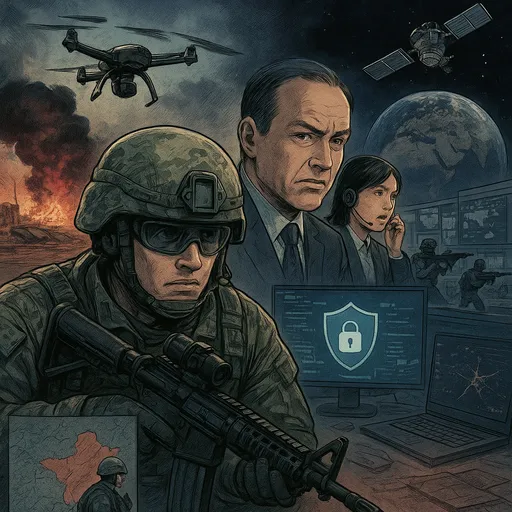
Reporting shows security threats expanding across multiple domains: kinetic attacks (mass-casualty drone strikes, airport assaults and border bombardments), state-linked hybrid operations and sabotage, and accelerating cyber and space-military competition. Governments and militaries are responding with heightened alert levels, personnel relocations, and plans to reorganize forces for unmanned and autonomous systems while convening experts on specialized threats such as chemical weapons. Regional flashpoints (the Gulf, the Korean peninsula, Abyei/Sudan–South Sudan, and the Sahel) reveal how local violence and state signaling can ripple into wider strategic concerns, including risks to commerce and undersea infrastructure. Simultaneous cyber vulnerabilities and high-profile data breaches show adversaries exploiting software and platform dependencies, prompting widespread site outages and policy debate on resilience and technological sovereignty.
Sources covering the Gulf emphasize a mix of immediate attacks on transport hubs and broader Iranian-linked strategic signaling. Reporting highlights airport strikes, tanker damage, embassy precautionary measures, and Tehran’s threats against critical infrastructure and military capabilities, framing these as both security incidents and deterrence messaging that raise regional risk.
European and allied sources warn that Russia is expanding covert and hybrid tactics—sabotage, targeted interference, and misinformation—to erode Western cohesion. German and NATO-aligned reporting frames the threat as tangible enough to raise military alert levels and prompt analyses on how Moscow could exploit decision-making frictions without large-scale conventional war.
Coverage from regional and international outlets underscores Pyongyang’s stepped-up military signaling—deploying new units, fortifications, and psychological tools like border loudspeakers. These moves are presented as deliberate escalation and testing of Seoul’s and allied responses, increasing the risk of miscalculation along the DMZ.
Multiple reports from African and international outlets document devastating unmanned strikes and bombardments in disputed border zones, particularly Abyei and the Sudan–South Sudan frontier, along with renewed violence in the Sahel. The perspective stresses civilian tolls, accountability gaps, and warnings that hasty peacekeeper withdrawals or weak state control will worsen humanitarian and security crises.
Tech and government sources describe a wave of cyber disruption driven by exploitable software flaws and targeted intrusions affecting public services and industry. The coverage frames the incidents—from mass site shutdowns to corporate ransomware or data breaches—as evidence that dependency on common platforms and weak digital resilience are strategic security liabilities.
U.S. and analyst reporting highlights rapid organizational moves to centralize and expand capabilities in space and unmanned/autonomous warfare. The perspective treats these changes as responses to rising demand across theaters and as potential catalysts of arms-race dynamics, prompting debate over force posture and ethical or budgetary implications.
Local and international outlets report a range of attacks—from urban explosions and school stabbings to killings during live streams and assaults on elected officials—emphasizing both the immediate human cost and the challenges of protecting vulnerable targets. The coverage frames these incidents as part of wider crime and political-violence trends that demand stronger protection and investigation measures.
Regional reporting focuses on state responses to transnational gang threats, including military-style operations in Haiti and diplomatic ultimatums from neighboring governments. The perspective highlights both the operational challenges of rescuing abducted soldiers and the broader security implications for regional stability and cooperation.
Reports from diverse outlets stress Beijing’s ambitions to expand naval power while actively contesting maritime encounters, portraying carrier planning and naval monitoring as strategic moves to reshape regional maritime balances. The viewpoint flags long-term geopolitical implications for freedom of navigation and regional security competition.
European commentary and defense reporting warn that deterrence is strained and public preparedness messaging is increasing, while international expert meetings address specialized risks like chemical-weapons threats. These pieces argue for strengthened readiness, faster decision-making, and international cooperation to counter emerging, multifaceted threats.