

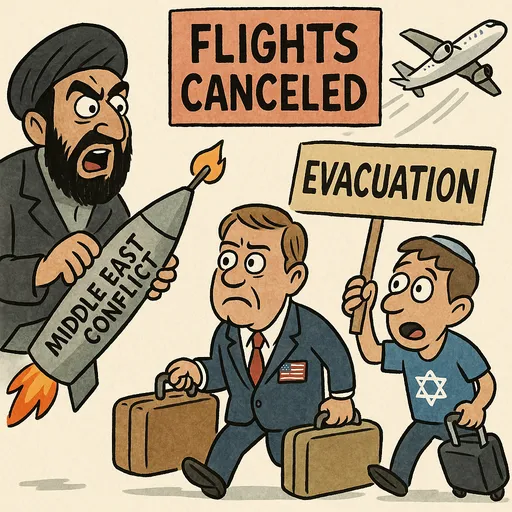
The escalating conflict in the Middle East, particularly involving Iran, the US, and Israel, has led to widespread flight cancellations, airspace closures, and urgent evacuation efforts by numerous countries. Governments from the US, European nations, and Asian countries have mobilized military and civilian resources to repatriate their citizens, while issuing travel advisories and urging nationals to register with embassies for safety. Wealthy residents in Gulf states like Dubai are undertaking costly private evacuations amid fears of expanding violence. The disruptions have severely impacted global air travel and commerce, with airlines and travelers scrambling to find alternatives. Diplomatic tensions and security concerns continue to complicate evacuation logistics and regional stability.
The US and allied Western countries emphasize urgent evacuation and travel warnings due to escalating hostilities and security risks. The US has ordered non-essential diplomatic staff to leave several Middle Eastern countries, conducted repatriation flights, and urged American citizens to depart immediately. European nations like France, the UK, Poland, and Sweden have also organized evacuations and crisis teams, highlighting a coordinated Western response to protect nationals amid deteriorating conditions.
Countries such as New Zealand, Australia, South Korea, India, Pakistan, Kyrgyzstan, and Singapore are actively evacuating their citizens and emphasizing safety amid the conflict. These nations have deployed aircraft, arranged repatriation flights, and issued advisories urging nationals to register with embassies. Their responses reflect a focus on logistical coordination and communication to manage the crisis affecting their expatriates in the Middle East.
Countries within or near the conflict zone, including Qatar, UAE, Saudi Arabia, and Jordan, face complex evacuation logistics and heightened security concerns. Qatar evacuated residents near the US Embassy, Emirates suspended flights, and Jordan coordinated special evacuation flights. The UAE's large expatriate population complicates evacuation efforts, while regional airspace closures disrupt travel. These states balance internal security with international diplomatic pressures amid escalating tensions.
Smaller countries such as Nepal, Moldova, Romania, San Marino, Andorra, Georgia, and Slovenia are actively monitoring the situation and organizing repatriation flights for their nationals. They emphasize embassy communication, registration of citizens, and practical travel guidance to ensure safety. These nations highlight the widespread impact of the conflict on diverse expatriate communities and the importance of government support in crisis management.
The conflict has caused significant travel chaos, with thousands of flights canceled and major hubs like Dubai and Doha affected. Wealthy individuals in Dubai are paying exorbitant sums for private evacuation flights, reflecting fears of escalating violence. Ordinary travelers face uncertainty and must seek alternative routes amid airspace closures. Airlines and travel industries are struggling to manage the fallout, underscoring the broad civilian impact of the conflict.