
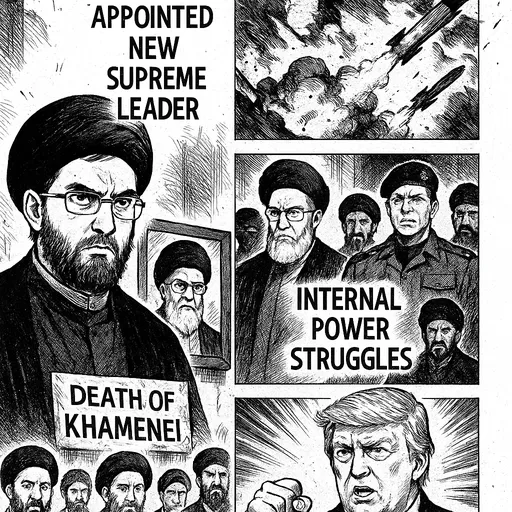
Following the death of Supreme Leader Ayatollah Ali Khamenei, reports widely indicate that his son, Mojtaba Khamenei, has been appointed as the new Supreme Leader, signaling continuity of the current regime's hardline policies. This succession process is occurring amid intense regional tensions, including Israeli and U.S. military actions targeting Iran's leadership institutions and efforts to disrupt the leadership vote. Internal power dynamics, especially the influence of the Revolutionary Guards, play a critical role in shaping the succession outcome. International actors, including U.S. President Donald Trump, have expressed opinions on Iran's leadership future, emphasizing the importance of internal regime figures over external alternatives. The transition raises significant questions about Iran's domestic stability and its geopolitical posture amid ongoing conflicts in the Middle East.
Sources from Iran and neighboring regions report that Mojtaba Khamenei, son of the late Supreme Leader, has been chosen as the new Supreme Leader. These reports emphasize the continuity of the current regime and the significant role of the Revolutionary Guards in influencing the succession. The appointment is seen as a critical development amid ongoing regional conflicts and internal political challenges.
Western media and analysts highlight the uncertainty and complexity surrounding Iran's leadership succession following Khamenei's death. They focus on the impact of U.S. and Israeli military actions disrupting the succession process and the broader geopolitical implications. U.S. President Donald Trump’s statements reflect skepticism about regime change and favor internal regime figures as successors, underscoring the strategic calculations of external powers.
Exiled Iranian figures and royalist commentators express views that Iran will not collapse automatically after Khamenei's death and emphasize the resilience of the regime. They provide alternative perspectives on the succession, often contrasting with official reports and highlighting the complexity of Iran's political future. These voices also reflect on the diminished prospects of former royal family members returning to power.