

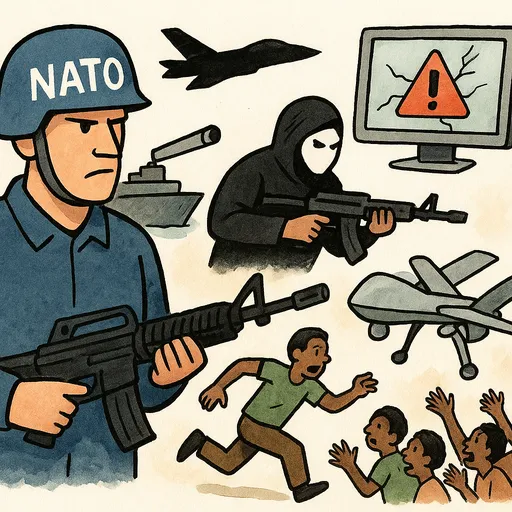
A broad range of reporting shows threats expanding across multiple domains: great-power intelligence and force posturing, state-led militarization, asymmetric attacks by non-state actors, and emerging cyber/AI vulnerabilities. NATO and allied countries are adjusting posture and procurement, while regional powers display new capabilities that raise maritime and border risks. Persistent violence in Africa and Haiti — including large drone strikes, mass abductions and cross-border interventions — underscores fragile governance and the humanitarian toll. Meanwhile, cyber incidents and the misuse of AI tools add a transnational, non-kinetic vector that complicates traditional responses and demands tighter defenses and coordination.
Western and allied sources emphasize a recalibration of intelligence and force posture in response to growing competition with Russia and China, including covert operations and industrial-security moves. The perspective frames capability expansion and public readiness as necessary deterrence amid active Russian signaling and espionage concerns.
Reports from multiple outlets portray Pyongyang as taking an increasingly hardline, militarized stance — from massive mine deployments to visible leadership inspections — heightening the risk of miscalculation. The coverage stresses regional alarm and the challenge this poses to diplomacy and alliance readiness.
Sources highlight Tehran’s public displays and claims of new munitions and drone production, and analysts tie these advances to elevated risks for shipping and regional stability in the Gulf. The angle treats Iranian signaling as both deterrent posture and a source of commercial and military vulnerability.
Regional reporting focuses on El Salvador’s military deployment to Haiti and active rescue operations as symptomatic of spiraling gang violence and fragile Haitian governance. The perspective frames cross-border military action as a contentious but pragmatic response to immediate security threats to personnel and regional stability.
Coverage from and about Africa emphasizes the sharp humanitarian and security impacts of drone strikes, inter-state proxy tensions, insurgent attacks, and spillover across borders. The viewpoint calls for stronger regional coordination, sustained peacekeeping, and caution against premature withdrawals that could worsen instability.
European sources stress reinforced defenses, procurement, and public preparedness amid elevated tensions and localized attacks at sea and near contested zones. The narrative links defense industrial policy, civil-resilience campaigns, and electoral politics as intertwined elements of national security planning.
Reports emphasize continuing terrorist threats across the Middle East and the need for sustained counterterrorism vigilance, with governments issuing travel advisories and conducting targeted operations. The framing balances immediate incident response with broader threat assessments tied to groups like ISIS.
Tech and security reporting warns that AI tools, software bugs, and server compromises are creating new attack surfaces for criminals and state-level actors, prompting emergency mitigations by banks and governments. The angle calls for faster patching, stronger controls on AI agents, and cross-sector resilience planning.
Regional pieces highlight violent prison riots, the formal designation of organized-crime groups as terrorists, and policy shifts aimed at tougher domestic security measures. The perspective sees institutional responses as attempts to reassert state control amid entrenched criminal threats.
A factual report documents a Russian aircraft distress event over Kazakhstan without wider attribution, reflecting aviation-safety and incident-response concerns rather than strategic signaling. The piece remains descriptive and cautious in its inferences.
Commentary from political and strategic sources links rising political violence and social fractures to threats against democratic institutions and enduring strategic doctrines. The perspective warns that domestic polarization and leadership choices can shape national security trajectories.
Local reporting on mass abductions in Khyber Pakhtunkhwa highlights persistent militant activity and law-and-order challenges in Pakistan’s border regions. The angle underscores immediate humanitarian concerns and investigative uncertainty about perpetrators.
A domestic-minor incident at the Pentagon about mishandling an artifact is framed as a lapse in institutional protocol and a reminder of non-combat vulnerabilities within major defense establishments. The piece flags operational stewardship and internal standards rather than external threats.
Coverage of planned tests of novel border technologies highlights ethical, safety and humanitarian debates surrounding unconventional deterrents at international frontiers. The viewpoint stresses the need to weigh operational utility against potential civilian harm and legal implications.