

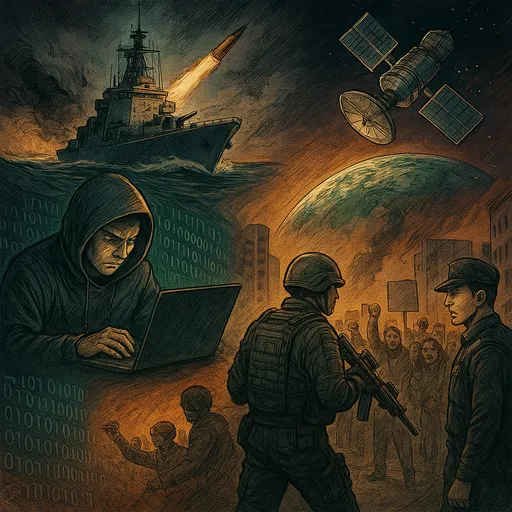
News sources describe a multi-domain escalation of security threats: state and proxy maritime attacks in the Gulf, growing Russian hybrid and space activity, and repeated high-casualty strikes across Africa. Western and regional governments are highlighting gaps in deterrence and logistics while unveiling strategies—from Arctic security plans to new military space units—to respond. Cyber intrusions and major IT outages underline vulnerabilities to non-kinetic disruption, and large-scale domestic crackdowns and extrajudicial violence raise human-rights concerns tied to security policy. Together these reports portray an international environment in which kinetic, cyber and informational threats are increasingly coordinated and driving policy and operational shifts among allies and regional actors.
European and Western reporting frames Russia as using a spectrum of tools—covert operations, satellite shadowing, disinformation and border interference—to project power and destabilize neighbors. Brussels and regional capitals see these actions as driving new security planning (including Arctic posture) and counterintelligence responses.
Western and Gulf-aligned outlets present Iranian actions and claims—mine incidents, attacks on ship engine rooms and explicit threats against merchant shipping—as an intensifying campaign that imperils international shipping. U.S. lawmakers and regional partners portray Tehran’s tactics as aggressive coercion warranting stronger naval and diplomatic responses.
Israeli sources emphasize building dedicated space capabilities as a strategic imperative, reflecting the view that space is now a contested warfighting domain. The creation of an IDF space branch is presented as a necessary adaptation to protect national intelligence and operations.
Regional and international reporting highlights catastrophic attacks in Abyei and repeated militant violence across Mali and Ménaka, framing the Sahel and contested border zones as theaters of persistent extremist violence. Observers stress the humanitarian toll and the challenge of protecting civilians amid weak local governance.
Gulf-region coverage links Houthi and related strikes to a widening risk environment that can force cancellations of major economic events and disrupt transport hubs. Saudi and regional authorities are shown balancing crisis response with attempts to normalize travel and commerce.
Business and security outlets signal that ransomware, large-scale data breaches and cloud outages are producing tangible operational and financial impacts, prompting heavy private-sector investment and remedial actions. Arrests alleged to involve foreign espionage underscore the blurred line between criminal cybercrime and state-directed operations.
Reporting from the Americas and Africa highlights how strong-handed security campaigns—mass detentions, states of exception and allegations of disappearances—are justified as necessary for public safety but raise serious due-process and human-rights questions. Commentators warn these policies may erode democratic norms and fuel long-term instability.
Coverage of decapitations and the murders of regime critics in host countries frames these incidents as transnational threats to political opponents in exile and a test for host-state protection and regional diplomacy. Journalists emphasize the chilling effect on opposition and the need for accountability.
Australian reporting treats violent assaults on MPs as potentially terror-related and as an alarming trend that has prompted specialist investigations and public-security concerns. Authorities are portrayed as mobilizing counterterror resources while the political class faces heightened vulnerability.
Coverage of cartel arrests and lethal operations against gangs in Haiti highlights ongoing law-enforcement campaigns that mix domestic policing with cross-border cooperation. These actions are depicted as necessary to restore order but also risk escalation and collateral harms.
Analyses from NATO and allied countries stress shortfalls in European deterrence and the need to shore up readiness amid great-power competition, while allied drills and statements from senior military leaders aim to signal resolve. Procurement delays and large-scale exercises are shown as key pressure points in sustaining collective defense.
Regional security reporting focuses on intelligence claims and legal steps against militant operatives, presenting state actions as efforts to prevent attacks on civilians and displaced populations. Authorities emphasize the centrality of actionable intelligence while observers note challenges of verification.
Regional reporting of a bomb threat on a Tel Aviv–Vienna flight that led to a military escort highlights routine peacetime air-security protocols and rapid coordination among states. The episode is framed as an example of vigilance in the face of transnational risks.
Coverage of an EU official’s evacuation after a drone alert underscores how the Ukraine war continues to produce cross-border security incidents and reputational risks for officials traveling to the region. Reports portray such episodes as symptomatic of the wider operational dangers associated with the conflict.
U.S.-focused commentary about the first military execution since 1945 links justice decisions to broader debates over deterrence, extremism and the symbolic messaging of counterterror policy. The piece frames the legal outcome as having implications for military morale and public perceptions of security policy.
Reporting of suspected rocket debris falling in Indonesia highlights growing concerns about space-launch safety, cross-border accountability and the terrestrial consequences of increased launch cadence. Authorities are portrayed as responding with investigations and coordination to mitigate hazards.
Coverage of North Korea’s threats to resume propaganda broadcasts and redeploy weapons frames Pyongyang’s statements as part of a pattern of coercive brinkmanship aimed at South Korea. Analysts warn such moves could raise the risk of miscalculation along a sensitive frontier.