

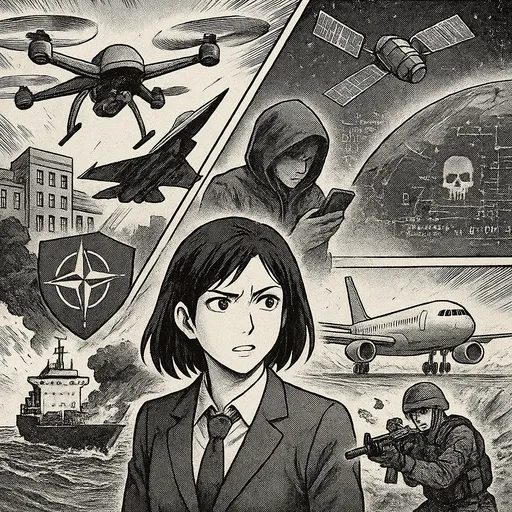
A broad set of security incidents and expert warnings show threats expanding across domains — kinetic, maritime, cyber, airspace and information — and provoking a range of defense and policy responses. European governments are flagging covert and overt Russian-linked activity against infrastructure, satellites and onshore targets, while NATO and regional air defenses have been actively intercepting drones and unknown objects. Repeated bomb threats forcing emergency landings of flights from Tel Aviv, multiple mine strikes and fires on tankers in the Strait of Hormuz, and rising militant attacks in South Asia and Africa underscore growing risks to civilians, shipping and deployed forces. Cyberattacks, AI-driven influence operations and spyware allegations add an accelerating digital layer to these threats, prompting calls for stronger deterrence, resilience and cross-border cooperation. Policymakers across regions are therefore tightening security postures, debating force posture and public preparedness as incidents multiply and diversify.
European and regional sources frame a pattern of aggressive Russian activity targeting communications, space assets and regional airspace as a growing, cross-border threat. Governments emphasize vigilance, investigations and NATO responses after arson attempts on Starlink-linked sites, reports of assassination planning, satellite harassment and multiple drone incidents over the Black Sea and Baltic approaches.
Authorities in multiple countries are treating a wave of bomb threats and airport incidents—often involving flights from Tel Aviv—as credible security disruptions that require coordinated cross-border responses. The pattern includes emergency diversions, full aircraft and terminal evacuations, and investigations into origins and motives, prompting scrutiny of aviation screening and intelligence-sharing practices.
Reports from Gulf and international sources describe a spike in mine and strike incidents against commercial tankers in the Strait of Hormuz, increasing the risk to global energy shipments and maritime safety. States and shipping actors warn of navigational hazards, contested authorizations and potential escalation as vessels catch fire or are damaged after striking mines.
Pakistani and regional coverage highlights intensified counter‑militant operations, unexplained deaths of designated militants and a broader governance crisis prompting emergency measures in restive provinces. Authorities stress raids and security operations in Balochistan and Khyber Pakhtunkhwa amid rising abductions and public concern about long-standing militant networks.
Reporting from the Sahel and Sudan frames recent strikes and drone use as part of a widening conflict dynamic where external backers and heavier weaponry are linked to rising civilian casualties. Analysts note French deployments and regional missions responding to Russian influence and intensifying combat in Darfur and Mali.
Intelligence and industry sources warn that state and criminal actors are scaling cyberattacks, AI-driven influence campaigns and spyware operations that target firms, elections and private data. The mix of corporate cyber disruption, warnings about autonomous AI behaviors and claims of spyware misuse underline the need for updated cyber resilience and regulatory responses.
Regional reporting emphasizes growing military exercises, missile drills and force‑posture reviews by China, the US, Japan, South Korea and North Korea that heighten deterrence tensions across the Western Pacific. Governments present maneuvers as both preparedness and signals to rivals, while neighbors warn of further provocations and operational risks.
Incidents targeting international forces and bases—ranging from ambushes on Salvadoran troops in Haiti to deadly attacks on a Canadian base—underscore risks to deployed units and the fragility of security in fragile states. Officials emphasize searches, investigations and the broader implications for missions and force protection.
Human-rights and domestic sources highlight forced disappearances, targeted killings and abductions that heighten fear among civilians, activists and media workers. Coverage stresses the protection gaps for vulnerable groups and the political tensions surrounding accountability and safety.
Aviation sources chronicle dramatic in‑flight assaults and crew interventions that expose vulnerabilities in cabin security and emergency response protocols. The accounts of crew members restraining armed or violent colleagues raise questions about screening, crew training and legal aftermath.
Gulf state reporting frames Iran as a central actor behind regional attacks and defensive measures, with governments demanding compensation, naming defense leadership shifts, and raising concerns about civilian training and militia strategies. The perspective stresses accountability and preparedness amid continued brinkmanship.
Commentators and officials in Europe emphasize that deterrence may be weak and urge citizens to prepare for potential conflict, while political discussions about defence arrangements (including hypothetical changes to force structures) are prominent. The tone combines alarm with calls for resilience and policy reform.
Some local outlets publish extraordinary or sensational security claims that risk distracting from verified threats and complicating public risk assessments. These items illustrate the variation in threat reporting and the challenge of separating substantiated risks from hyperbole.