

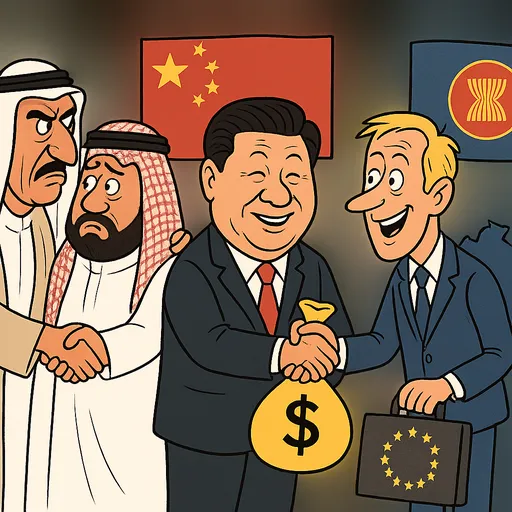
Across regions, bilateral deals and commitments are intensifying around three main axes: security alignments in the Middle East, China’s broad development and investment outreach, and an uptick in trade, infrastructure and technical cooperation among diverse partners. Egypt’s diplomatic and military support for Saudi Arabia and related regional pledges underscore growing security cooperation amid escalating tensions. China appears as a dominant bilateral partner—signing pacts, providing debt relief, funding projects and expanding technical cooperation from Africa to Central Asia and the Pacific. Meanwhile Europe, ASEAN and other partners advance trade, connectivity and regulatory actions, from a San Marino-EU association agreement to Australia–UK tariff cuts, signalling pragmatic bilateralism in both economic and governance spheres.
Libya (as reported by a European venue) frames closer ties with European partners around oil and gas cooperation, seeking investment and project collaboration. Madrid hosting the forum signals mutual interest in stabilizing energy partnerships and opening investment channels.
Sri Lankan reporting highlights the Maldives’ positive reception of India’s decision to roll over a currency swap, emphasizing immediate liquidity and financial stability benefits. The move is presented as a pragmatic bilateral financial lifeline.
Syrian coverage emphasizes Turkey’s receipt of Russian diesel and plans for a second Black Sea gas platform, underlining bilateral energy cooperation and regional infrastructure expansion. The perspective frames these ties as consequential for energy security and market dynamics.
Austrian reporting relays Egypt’s announcement that Saudi Arabia will receive defense assistance, portraying Cairo as bolstering Riyadh’s security posture. The framing suggests a coordinated regional security posture among Arab partners.
Egyptian sources present a strong, unified stance of political and institutional support for Saudi Arabia amid regional tensions, stressing solidarity and readiness to assist. Officials emphasize alignment on security concerns and broader regional stability.
Liberian reporting highlights strengthened ties with China on media training and with Morocco on cybersecurity, presenting bilateral engagement as capacity-building and institutional cooperation. The perspective stresses practical training, exchanges and integration into regional digital security networks.
Indonesia-focused coverage of Singapore’s regulatory action frames Singapore as holding Indonesian firms accountable for fires that cause transboundary haze, emphasizing enforcement and cross-border environmental responsibility. The stance highlights bilateral/regional environmental governance pressures.
Singapore reporting on a Canadian investor reviving India’s bank privatization underscores foreign direct investment dynamics and cross-border financial interest in India’s reform agenda. The piece frames the deal as a catalyst for privatization momentum.
Guam reporting highlights a new Australia–United Kingdom trade deal focused on tariff cuts to broaden market access, reflecting post-Brexit economic reorientation and stronger bilateral commercial ties. The perspective emphasizes expected sectoral gains and reduced trade barriers.
Guam coverage portrays U.S.–EU moves to ease trade friction as a pragmatic pre-summit diplomatic step intended to smooth transatlantic economic relations. The framing underscores diplomacy’s role in preventing trade disputes from complicating higher-level meetings.
Belgian reporting spotlights a collaborative, practitioner-led alliance between Belgian and Luxembourg jewelers to curb theft, framing cross-border industry cooperation as effective and community-driven. The piece highlights operational results and shared security interests.
Bolivian coverage of Brazil calling on Argentina to withdraw its ambassador frames a sharp bilateral diplomatic rupture, signaling a deterioration in regional relations and raising prospects of a protracted dispute. The perspective focuses on the political fallout and diplomatic escalation.
Guinean reporting underscores China’s deepening footprint in development cooperation, highlighting health and nutrition projects and broad economic partnerships. The perspective presents Beijing as a determined development actor delivering practical programs.
San Marino’s coverage frames the Association Agreement signing with the EU as the culmination of a long process toward deeper integration, emphasizing historical ties and public ceremonial importance. The tone conveys national significance and continuity in European engagement.
Surinamese reporting shows a twofold approach: diplomatic outreach to strengthen trade ties (via Vietnam) and cultural reaffirmation of long-standing relations with Spain. The perspective highlights both economic diplomacy and soft-power cultural celebration.
Romanian items emphasize security partnership with the United States—via proposed investments to retain troops—and highlight national scientific contributions to international projects. The stance portrays Romania as deepening security ties while projecting scientific capability.
Tongan and Fijian reporting reflect regional attention to China’s security, aid and governance models: Tonga reviews China–Pacific cooperation and Fiji considers lessons from a Beijing hotline for public service delivery. The view underscores both opportunity and strategic caution in Pacific–China ties.
Tanzanian reporting frames a newly signed pact with China as targeted at vocational training and youth employment, portraying bilateral ties as developmental and skills-focused. The perspective emphasizes capacity-building and job creation outcomes.
Kyrgyz reporting presents a multi-track engagement: plans for a joint legal assistance center with Russia, introduction of Chinese buses to improve air quality, and an interest in expanded investment cooperation with Hong Kong. The perspective highlights diversification of partners and practical modernization aims.
Mauritanian reporting notes European countries pushing to extend the EU–Mauritania fishing protocol, framing the issue as an economic and diplomatic matter tied to fleet interests. The perspective centers on negotiation leverage and resource access.
Canada–Quebec reporting of Marco Rubio’s visit to Uzbekistan frames it as an effort to strengthen U.S. trade presence in Central Asia, reflecting Washington’s growing economic outreach in the region. The view stresses political backing for expanded market ties.
Saudi reporting highlights Egypt’s pledge of full support for Saudi Arabia against Houthi attacks, underscoring concrete regional security cooperation. The article frames the commitment as a response to shared threats and the need for coordinated defense measures.
Comoros reporting celebrates the 40th anniversary of the Nairobi Convention, framing it as a milestone in Western Indian Ocean environmental collaboration and shared marine stewardship. The perspective emphasizes regional coordination and Tanzania’s hosting role.
Comoros analysis explains Abu Dhabi’s rising investment in Moroni as a geopolitical and economic shift that eclipses Saudi influence, portraying investment as a lever of strategic influence. The perspective highlights external actors shaping local trajectories.
Polish reporting examines border tensions and political rhetoric, suggesting that structural strategic and economic factors underlie cross-border concerns beyond partisan slogans. The view frames diplomacy as dependent on broader systemic issues.
Laotian reporting shows an active diversification strategy: strengthening ties with Azerbaijan, Singapore and Vietnam and cooperating with Thailand to fight cybercrime and money laundering. The perspective stresses economic opening, investment attraction and regulatory cooperation across multiple partners.
Central African reporting highlights financing for the Douala–Bangui corridor as a bilateral/regional infrastructure push to improve trade and connectivity. The perspective frames investment as key to cross-border economic flows.
Kazakh reporting of the president’s visit to an Armenian expo center conveys ongoing diplomatic outreach and bilateral engagement with Armenia. The perspective underscores state-level representation and event diplomacy.
Malaysian coverage stresses practical cooperation between Laos and Thailand to tackle online scams and money laundering, emphasizing information-sharing and enhanced cross-border enforcement. The perspective situates the pact within regional financial integrity efforts.
Cuban reporting on high-level meetings frames relations with the Dominican Republic as resilient and historically deep, emphasizing political solidarity and enduring bilateral friendship. The view highlights continuity in diplomatic bonds.
Cuban-reporting of CEPAL’s praise frames Mexico’s export diversification as a resilience strategy amid trade renegotiations, underscoring success in expanding into emerging markets. The perspective highlights policy achievements in external trade orientation.
Vietnamese reporting of Singapore’s deputy PM frames closer Singapore–China cooperation as a vehicle to strengthen ASEAN in areas like digitalisation and the green economy. The stance emphasizes integration and practical collaboration for regional resilience.
Hungarian reporting describes ministerial travel to Transylvania amid criticism of cross-border policies, framing the visit as part of cultural and social relations concerns. The perspective notes domestic backlash and contested diaspora outreach.
Kuwaiti reporting highlights an agreement to create a World Bank-managed multi-donor fund for Syria’s recovery and reconstruction, framing it as a major step toward mobilizing concessional finance and technical support. The perspective stresses international coordination for post-conflict rebuilding.
Nicaraguan analysis interprets Managua’s withdrawal from Parlacen as removing a diplomatic sanctuary for regime figures, framing it as a recalibration of regional posture with political consequences. The viewpoint is critical and analytical about strategic implications.
Palestinian reporting on Barcelona University launching a Palestinian studies chair frames the move as strengthening academic and cultural ties with Spanish institutions and promoting international scholarship. The perspective emphasizes soft diplomacy via education.
Jordanian coverage reiterates statements by Egypt’s National Defense Council pledging full support for Saudi Arabia, presenting Cairo’s institutional position as regionally consequential. The view stresses formal institutional backing rather than ad-hoc statements.
Tajik reporting highlights plans to expand trade and joint production with China and technical exchanges on cotton farming, portraying bilateral ties as practical, technology-driven and trade-oriented. The perspective emphasizes knowledge transfer and industrial cooperation.
Russian reporting of Vietnam’s free trade agreement with EAST after lengthy negotiations frames the deal as a major step to boost bilateral trade and integration, while noting implementation challenges. The view underscores economic opportunity tempered by technical complexities.
Bahraini reporting notes Egypt’s National Defense Council approval to send troops to Saudi Arabia pending parliamentary debate, framing Cairo’s action as a formal escalation of military support. The perspective highlights procedural and political dimensions of such commitments.
Dominica reporting highlights a FAO handover of solar ferti-irrigation systems as international technical cooperation to boost agricultural productivity. The perspective frames the initiative as practical development aid supporting climate-smart farming.
Sint Maarten coverage of the new Joint Court president stresses a regional push to recruit more Caribbean judges and expand access to justice, portraying the appointment as a step toward stronger intra-Caribbean legal capacity. The view prioritizes regional institutional strengthening.
Vanuatu reporting shows two parallel diplomatic-economic tracks: expanding tourism links with Australia and pursuing a formal partnership with China’s Hunan province to attract investment. The perspective underscores small-state outreach to multiple partners for development.
Rwandan reporting on the new South African envoy’s reception frames the meeting as routine diplomatic engagement aimed at strengthening bilateral ties and cooperation. The perspective emphasizes cordial state-to-state relations and continued dialogue.
Eswatini reporting presents Taiwan’s plan to create roughly 1,000 jobs annually as bilateral economic cooperation focused on employment generation. The perspective highlights development and labor-market benefits from bilateral engagement.
Thai reporting shows the Australian Retirement Trust increasing interest in long-term investments in Thailand, framing the move as deeper financial ties and cross-border capital flows. The perspective emphasizes investment opportunities and financial sector linkages.
UAE reporting reiterates plans for a World Bank-managed recovery and rebuilding fund for Syria, stressing mobilization of donors and governance arrangements for reconstruction. The perspective emphasizes coordinated international support under multilateral management.
Kenyan reporting on Netflix securing exclusive Spanish rights for 2030 World Cup matches frames cross-border media deals as disruptive to traditional broadcasters and indicative of platform-driven globalization. The view centers on commercial and market implications.
Nigerian reporting covers Liberia’s conviction of former ministers in a Saudi-linked rice deal, framing the case within anti-corruption efforts and governance reforms. The perspective underscores accountability and its domestic political implications.
Papua New Guinea reporting relays the Solomon Islands prime minister’s appeal for scholars abroad to return and contribute to nation-building, framing diaspora engagement as a priority for capacity development. The perspective emphasizes human capital repatriation.
Burkinabé coverage highlights bilateral and regional customs cooperation briefings and the formal reception of Canada’s new ambassador, framing both as steps to improve trade facilitation and diplomatic ties. The perspective focuses on practical governance and partnership-building.
Cambodian reporting frames a UNCLOS-based agreement with Thailand as a maritime confidence-building measure designed to reduce tensions and enhance cooperation in shared waters. The perspective prioritizes legal frameworks and de-escalation.
Korean reporting highlights Egypt’s declared readiness to assist Saudi Arabia against Houthi threats, stressing regional security coordination and implications for coalition dynamics. The view underscores potential operational cooperation.
Armenian reporting of Georgia’s prime minister emphasizes shared natural heritage protection with South Caucasus neighbors, framing bilateral environmental cooperation as part of regional diplomacy. The perspective stresses conservation as a cooperative agenda.
Azerbaijani reporting notes Lebanon urging Iran to appoint a new ambassador, framing it as an effort to restore full diplomatic channels and manage regional relationships. The perspective highlights diplomatic normalization aims.
Ethiopian reporting outlines a strategy combining internal stabilization, economic diplomacy for investment and debt-relief financing, and high-level contacts with partners to deepen bilateral ties. The perspective emphasizes a multi-vector foreign policy advancing strategic interests.
Macau reporting evaluates asset exposure in Macau and the UAE as growth drivers for international gaming firms, framing cross-border assets as central to corporate expansion strategies. The perspective highlights investor, regulatory and market risks.
Myanmar reporting of China Datang’s plans for new energy projects frames the development as deepening bilateral economic ties and boosting Myanmar’s energy capacity. The perspective notes investment timelines and regional implications.
Myanmar reporting on Japan’s partnership with the U.S. and Australia to build submarine cables highlights strategic infrastructure cooperation to secure communications and enhance connectivity. The perspective stresses diversification and resilience in regional telecom links.
Qatari reporting of high-level meetings in Beirut frames Doha as ready to support Lebanon’s energy needs and contribute to regional stability through bilateral engagement. The perspective emphasizes constructive, pragmatic aid and diplomacy.
Qatari short reporting reiterates Cairo’s public readiness to defend Saudi sovereignty, reinforcing the picture of close Egypt–Saudi coordination. The perspective underscores diplomatic affirmation across regional media.
Togolese reporting describes a multi-pronged foreign policy: learning from Xiamen’s port, signing a dozen multisectoral agreements in Beijing, relaunching ties with Egypt and securing partial debt cancellation. The perspective presents a strategy of leveraging Chinese engagement while diversifying partnerships.