
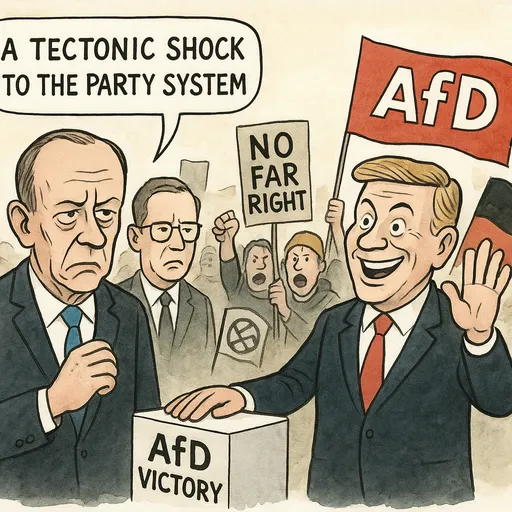
A far-right surge in Saxony-Anhalt produced a historic AfD victory that many outlets call the first state-level breakthrough of its kind since World War II, forcing national soul‑searching about party dynamics and voter anger. Chancellor Friedrich Merz and other mainstream leaders described the result as a tectonic shock to the party system, even as the AfD insists it has a clear mandate to govern and explores coalition options. Thousands of protesters and civil society groups mobilized across German cities, underscoring deep social polarization and broad public pushback. International reactions ranged from EU concern and warnings about regional stability to opportunistic rejoicing from geopolitical rivals, while analysts probe the economic and cultural drivers behind the party’s gains and what it means for Germany’s future politics.
Reports from multiple sources emphasize the stunned reactions within Germany's mainstream parties, especially Chancellor Friedrich Merz, who called the result a tectonic shift. Coverage focuses on the political crisis and uncertainty for CDU leadership and coalition stability as parties grapple with how to respond.
Many outlets frame the Saxony-Anhalt result as a historic first — a far-right party topping a state vote at the scale not seen since the postwar era. These pieces stress the numerical results, the AfD's strong vote shares, and the potentially lasting change to regional and national political balances.
Numerous reports document large street demonstrations and civic mobilization opposing the AfD's rise, portraying a strong public backlash against far‑right gains. Coverage highlights peaceful mass protests in Berlin and other cities as an immediate democratic response to the election outcome.
International outlets emphasize worry about broader European and geopolitical consequences, from EU institutions to adversarial actors reacting to the AfD win. These pieces highlight concerns about Euroscepticism, security implications, and opportunistic external responses such as Russian commentary.
Several reports present the AfD's immediate push to turn electoral success into governing power, including candidate profiles and explicit calls for mandates or early elections. Coverage examines coalition math, the party’s willingness to partner with unusual allies, and candidate Ulrich Siegmund's emergence.
Analytical pieces from academics and commentators probe the drivers behind the AfD’s advance and assess potential long‑term impacts on Germany and neighboring states. They consider voter grievances, media dynamics, comparisons to other populist upsets, and regional security or policy risks articulated by EU partners.
Some reports focus on the AfD’s proposed policy measures and the reactions of institutions such as churches and civic groups. Coverage outlines proposed shifts on migration, education and cultural policy, and documents promises from religious bodies to speak out against extremist positions.