
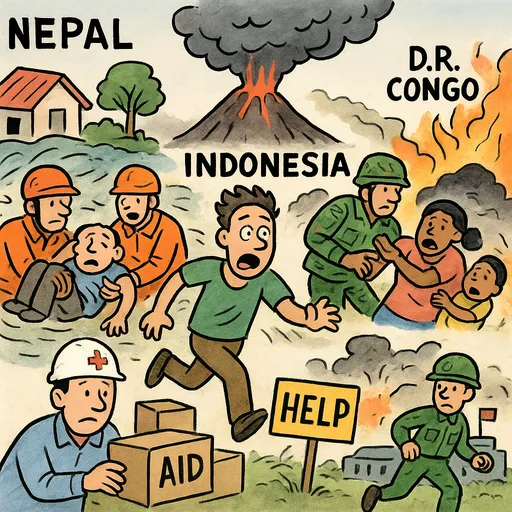
A series of major disasters — most prominently catastrophic floods in Nepal and a volcanic eruption in Indonesia — have driven large-scale search-and-rescue operations, mass evacuations and widespread disruption to travel and services. Rescue teams reported numerous miraculous survivals even days after the Nepal floods while official death tolls continued to climb, prompting UN appeals and diplomatic briefings for international support. Separate crises, including deadly fires in the Democratic Republic of Congo, explosions at a Bolivian military base, landslides and mudslides in China, and regional wildfires and haze in Southeast Asia, have compounded humanitarian needs. Governments, militaries and aid organisations are testing preparedness tools, deploying field hospitals and coordinating cross-border assistance as they manage immediate relief and longer-term recovery challenges.
Reporting centers on Nepal’s overwhelming flood disaster, rescue successes and rising casualty figures, often emphasizing domestic response and international appeals for aid. Stories highlight on-the-ground rescues, community leadership and coordination with foreign partners to sustain search-and-rescue and relief operations.
Coverage highlights Indonesia’s volcanic activity and its immediate impact on aviation, schools and local communities, with regional airlines and authorities prioritising safety and operational decisions. Reports underscore cross-border travel disruption and the broader economic and public-health precautions prompted by ash plumes.
Articles focus on the immediate human toll and rescue efforts at a Kinshasa wedding hall fire, stressing local emergency response and investigations into venue safety. Coverage conveys the tragedy’s implications for public-safety standards at large gatherings.
Reporting frames the Ebola outbreak as an escalating public-health emergency in eastern DRC, with health authorities and the WHO mobilising vaccines and containment measures. Stories highlight strained local health systems and calls for enhanced surveillance, testing and international support.
Coverage documents powerful explosions at a Bolivian military facility, emphasising casualties, many missing personnel and ongoing search-and-rescue and investigative efforts. The reports reflect national security and humanitarian concerns as officials reconcile casualty figures and respond to survivors.
Articles report on fatal military aircraft crashes during public airshows in Greece, focusing on emergency response, pilot fatalities and ensuing safety investigations. The coverage raises questions about public safety protocols at aerial demonstrations.
Reports concentrate on maritime tragedies — from trawler sinkings to passenger boat overturns — highlighting coastal rescue operations and recovered casualties. Stories underscore persistent challenges in maritime safety and the intensity of search-and-rescue missions.
Coverage details storm-driven landslides and flood evacuations in China, emphasising rapid response, large-scale relocations and community evacuations to reduce risk. Reports show authorities balancing immediate rescue work with preventive measures like city relocations in high-risk zones.
Reporting focuses on the acute water supply and contamination problems affecting Harare residents, highlighting public-health risks and local efforts to restore safe water access. The perspective stresses urgency for infrastructure fixes and emergency measures.
Articles portray cross-border haze from Indonesian wildfires as a regional health and environmental emergency, with neighbouring countries declaring emergencies and issuing air-quality warnings. Coverage also includes wildlife rescues and calls for coordinated mitigation.
The report describes government-led reconstruction contracts to build homes for families still affected by Hurricane Maria, emphasising institutional commitment to long-term recovery and housing resilience. It frames reconstruction as a central element of disaster recovery policy.
Coverage emphasises preparedness as Hurricane Lowell approaches Hawaii, with authorities urging residents to secure property and monitor advisories amid shifting forecasts. The perspective stresses vigilance and readiness despite track uncertainty.
This cluster groups non-conflict health crises — large measles outbreaks and mass hospitalisations linked to food programmes or avian influenza — highlighting strained health services and urgent need for medical response. Reporting focuses on caseloads, hospital capacity and public-health warnings.
Reports emphasise disaster preparedness measures, including international medical drills, a Royal Navy drone test for hurricane response, deployment of a Qatari field hospital and school safety drills. The coverage frames these efforts as proactive steps to bolster rapid-response capacity and humanitarian readiness.
Stories document smaller-scale but severe safety incidents — a child found dead after falling into a well, a man injured on a metal fence, and inflatable play-structure injuries — underscoring everyday risks that require emergency medical response and improved safety measures.
This cluster highlights civilian displacement and the wait to return home, whether due to conflict along the Cambodia–Thailand border or drought-driven emergency declarations in South Sudan. Coverage stresses prolonged humanitarian needs and the slow process of safe return.
The Mosul Eye profile illustrates how local, real-time information-sharing enabled civilians to escape a violent occupation, highlighting the lifesaving role of grassroots communications in crises. The perspective underscores non-traditional tools in evacuation and civilian protection.
Coverage focuses on Gazans repurposing aid materials to rebuild homes amid scarce construction supplies, highlighting improvisation and resilience amid constrained humanitarian flows. The perspective stresses gaps between aid delivery and reconstruction needs.
The report on a contested death toll from a pipeline incident reflects tensions between government figures and NGO claims, illustrating challenges in accountability and casualty verification after infrastructure disasters. Coverage emphasises conflicting narratives and the need for independent inquiries.
This item reports a fast-moving forest fire in France that burned hundreds of hectares and prompted evacuations, highlighting local firefighting efforts and civilian displacements. The perspective is focused on regional emergency suppression and public safety measures.