
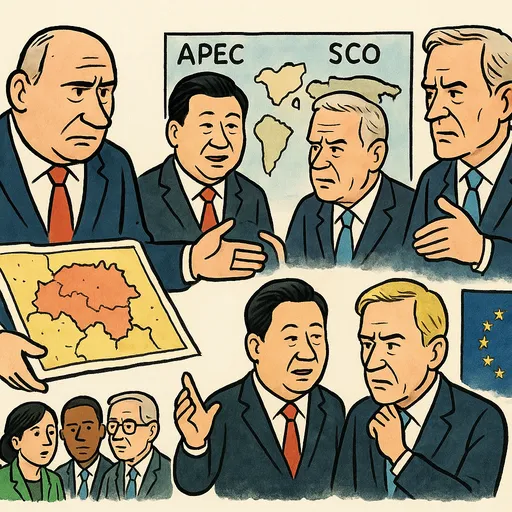
World leaders are intensifying high-level diplomacy across multiple hotspots, with renewed shuttle diplomacy and mediation efforts focused on ending the war in Ukraine. Great-power summitry and bilateral engagement — from APEC sidelines to SCO meetings and planned US–China interactions — reflect competitive strategic jockeying as well as attempts to manage shared risks. Europe is wrestling with questions of values, cohesion and regional tensions, particularly over the Balkans and internal political shifts, even as NATO and EU institutions consider security measures. At the same time regional and smaller states are pursuing pragmatic engagement on development, stability and normative issues, from African multilateral coordination and Caribbean forums to Middle East ceasefire appeals and Syria’s tentative disarmament steps.
This cluster highlights active diplomatic initiatives to halt or temper the Russia–Ukraine conflict, featuring proposals for truces, mediation teams and high-level shuttle diplomacy. Sources reflect cautious optimism about new talks while noting that violence, setbacks and distrust could quickly undermine negotiations.
Reports focus on summitry and bilateral engagement among the major powers as both competition and pragmatic cooperation, covering APEC sidelines, SCO initiatives and US–China talks on issues like AI and state visits. The pieces underscore that these interactions shape regional security architectures and global governance agendas.
European sources stress the importance of shared values and institutional credibility while confronting regional flashpoints — notably Serbia’s controversial gestures and broader Balkan disputes — and domestic political shifts such as Italy’s government longevity. The coverage highlights pressure on EU cohesion and the challenge of reconciling normative stances with diplomatic pragmatism.
Leadership statements and diplomatic exchanges center on de-escalation, humanitarian protection and appeals for ceasefires, with regional and external actors urging restraint and dispute management. Qatar, Egypt, the UAE, Türkiye and other interlocutors are active in pushing diplomatic avenues and UN engagement.
African governments and UN representatives are deepening coordination on development, conflict management and stabilization, reflecting both regional ownership and international partnership. Coverage highlights country-level dialogues, UN resident coordination, and cross-border security concerns that drive multilateral responses.
Regional diplomacy in Latin America is dominated by sovereignty claims and bilateral frictions, with renewed attention to the Falklands/Malvinas dispute and strains among neighbours. Leaders frame these issues as matters of national pride and leverage them in broader diplomatic positioning.
Small states and regional bodies are actively asserting their agendas through forums and targeted diplomacy, from Pacific and Caribbean engagements to ASEAN normalization efforts and civil-society reflections on representation. These actors emphasize pragmatic cooperation, capacity-building and regional security concerns in interactions with larger powers.
Syria’s officials are signaling steps toward rehabilitation — including tourism revival and destruction of legacy chemical stockpiles — seeking to demonstrate compliance and attract reconstruction engagement. External observers stress the need for transparency, verification and international confidence-building.
European security coverage centers on responding to suspected attacks, surveillance concerns and the maintenance of diplomatic channels with contentious actors. Governments stress both deterrence and pragmatic contact as complementary tools to preserve stability and open lines for negotiation.
Coverage of the SCO meeting in Bishkek frames the bloc as a venue for regional security coordination and for advancing member states’ strategic priorities. Reports note discussions about Kyrgyzstan’s status and broader cooperation without detailing immediate, binding outcomes.
Incidents of cultural or symbolic friction illustrate how soft-power gestures can provoke diplomatic sensitivities, particularly where national identity and territorial issues are involved. Observers note that these episodes complicate broader bilateral relationships even when they seem minor.
The United Nations and multilateral fora are active sites for symbolic and practical changes — from map representation to mediation initiatives — reflecting efforts to rebalance global narratives and institutions. These actions underline ongoing debates about representation, norms and the tools for collective problem-solving.