

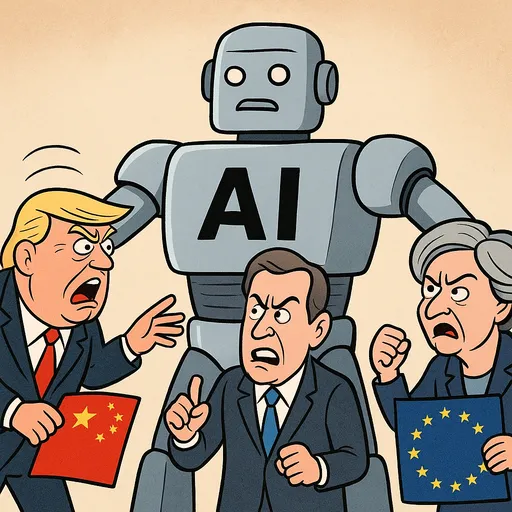
Reporting highlights a rapid narrowing of the AI gap as Chinese firms advance, with some customers citing cost and performance advantages of Chinese models. That rise has intensified pressure in the United States for stronger policy responses, from lawmakers proposing an emergency 'kill switch' to political scrutiny of the administration. European analysts warn that uncontrolled AI models and opaque Chinese agreements could erode EU digital sovereignty and call for coordinated defensive measures. Together the pieces show accelerating US–China tech competition driving urgent debates over regulation, national security, and strategic autonomy.
US sources emphasize an urgent need for domestic policy tools to rein in risky AI behavior and to respond to competitive pressure from China. Lawmakers propose measures like an AI 'kill switch', while political leaders face scrutiny to protect national security and industry competitiveness.
Coverage from outside the US highlights Chinese firms' rapid advances and growing competitiveness, portraying China as increasingly able to challenge American AI leadership. The perspective frames technological progress by the 'Four Heavenly Kings' as shifting the balance in global AI competition.
European analysis warns that uncontrolled AI models and secretive foreign pacts — specifically involving Chinese actors — could limit EU policymaking and threaten strategic autonomy. The view calls for coordinated EU responses to safeguard digital sovereignty and mitigate security risks.