
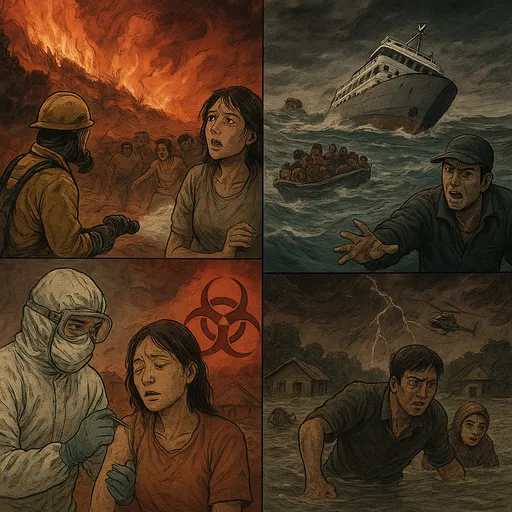
A wave of heat-driven wildfires across southern Europe has forced large evacuations, stretched firefighting resources, and produced significant health impacts amid record temperatures. Concurrently, maritime disasters — including ferry sinkings and migrant boat incidents — have produced heavy casualty counts and large-scale search-and-rescue operations in West Africa and Guyana. A major Ebola outbreak in eastern DRC and neighboring Uganda continues to claim lives and demand sustained international public health response and vaccination efforts. Severe storms, flash floods and tropical cyclones from Chile to the Gulf Coast of the United States have isolated communities and prompted disaster declarations, while conflict and attacks have damaged humanitarian infrastructure and endangered aid workers, complicating relief delivery. National and international relief measures, from field hospitals and repatriations to donated boats and reorganized Red Cross preparedness, are being mobilized but face security, logistical and climate-driven challenges.
News sources emphasize a region-wide crisis of extreme heat fueling dozens of large wildfires across Spain, France, Italy and Sicily, with mass evacuations and sustained firefighting operations. Reporting highlights both the immediate emergency response and broader public-health consequences of heatwaves, including excess deaths and overwhelmed hospitals.
Reports from regional and international outlets stress the rising death toll from the Ebola outbreak in eastern DRC and cross-border spillover into Uganda and the urgent need for vaccination, surveillance and international support. Coverage focuses on numbers, scale of transmission, and calls for sustained public-health action to contain the epidemic.
Reporting from affected states highlights deadly maritime incidents — ferry sinkings off Guyana and migrant boat losses off Mauritania — and the large-scale search-and-rescue, recovery and investigation efforts underway. Stories underline both immediate humanitarian needs for survivors and the longer-term safety and regulatory questions raised by these voyages.
Local news accounts focus on acute urban incidents — tram collisions, gas explosions at construction sites, nightclub fires, institutional fires and deadly road or crowd accidents — and emergency responses to rescue, treat and investigate. Coverage emphasizes first-responder mobilization and subsequent safety and regulatory inquiries.
Reporting links destructive storms and flash floods from Chile to the Balkans and Louisiana with government disaster declarations, evacuations and emergency relief actions, while other pieces highlight preparedness spending and capacity-building ahead of expected events. Coverage emphasizes both immediate rescue needs and investments in resilience, such as budget transfers, Red Cross reorganization and donated equipment for remote response.
Sources report on incidents that directly threaten relief delivery and health campaigns — attacks on polio teams, damage to a UNICEF humanitarian warehouse near Kyiv, and conflict-driven humanitarian crises in Sudan and Somalia — stressing how insecurity impedes aid and endangers workers. Coverage calls attention to protection needs for civilians and humanitarian staff and the operational constraints these attacks create.
Reports describe multiple relief-focused actions: Spanish field hospitals completing missions, repatriation efforts for nationals fleeing xenophobic violence, and local teams caring for rescued pets after disasters, reflecting both large-scale and community-level humanitarian priorities. The coverage underscores ongoing international cooperation, consular assistance and the human dimension of reunification and care in crises.