

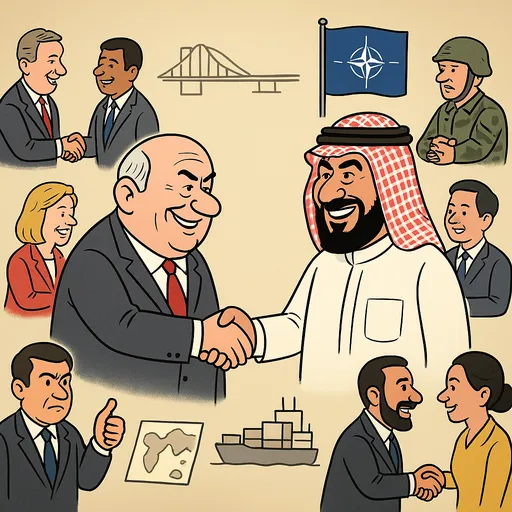
This batch of reporting is dominated by a major U.S.–Saudi civil nuclear cooperation agreement that many outlets treat as a strategic milestone while others warn of proliferation and regional security risks. Beyond that headline, governments across regions announced a wide range of bilateral deals: connectivity and transport links were restored or expanded, trade and investment agreements were advanced, and development and capacity‑building partnerships were launched. NATO and regional security cooperation featured through basing, refuelling and defense deployments, while smaller states negotiated consular, labor and digitalization arrangements to deepen people‑to‑people and economic ties. Overall the coverage highlights a mix of strategic-level pacts with far‑reaching geopolitical implications and smaller, practical bilateral measures aimed at economic recovery, mobility and institutional cooperation.
Multiple sources report a formal U.S.–Saudi civil nuclear cooperation agreement that could permit Saudi enrichment and extensive U.S. industry involvement. U.S. and Saudi officials frame it as peaceful energy cooperation and strategic partnership, while observers and some outlets stress proliferation risks, potential weakening of non‑proliferation norms and regional security consequences.
Reports highlight resumed or new air services and travel facilitation as a vehicle for economic recovery and stronger people‑to‑people ties. Governments and carriers emphasize tourism and business benefits while some measures (passports, routes, licensing services abroad) reflect efforts to ease cross‑border movement.
Pakistan is engaged in multi‑vector outreach—seeking a large U.S. economic support facility while also pursuing deeper technology cooperation with China. Officials frame these moves as necessary to stabilize the economy and harness technology for practical uses such as smart farming.
Laos is deepening ties with several partners through agricultural market access, industry cooperation, livestock safety projects and expanded labor opportunities abroad. Donors and partners emphasize capacity building and export market diversification as immediate objectives.
Central Asian states report a mix of visits and sectoral pacts focused on trade, strategic partnership and industrial cooperation. Governments present these ties as steps to strengthen regional supply chains, mineral development and infrastructure cooperation with international partners.
Australia, regional partners and external donors are advancing programs in security, infrastructure, training and development across Pacific island states. The coverage frames these deals as practical investments in policing, construction skills, public services and diplomatic outreach, with small states also strengthening ties with new partners.
African governments are pursuing foreign investment, agricultural leases, regional data exchange and stronger economic partnerships to spur development. Donor and investor activity is portrayed as seeking to modernize sectors from finance to agriculture while opening markets to international firms.
Several reports cover NATO and bilateral security steps—approvals for U.S. refuelling aircraft, extended troop or mission mandates and cooperation on regional operations. Host states emphasize alliance interoperability and operational support, while coverage notes implications for regional military posture.
Commercial arrangements include major rail coordination in North America, corporate investments and free‑trade initiatives that governments pitch as ways to expand markets and improve connectivity. Industry statements and government releases highlight customer benefits and longer‑term economic integration.
States are restoring or deepening diplomatic engagement—reopening embassies, hosting visiting ministers and marking protocol gestures like condolence books or ambassadorial honors. These actions are framed as normalization or reinforcement of bilateral ties after periods of disruption.
Reports describe practical bilateral steps to ease consular services, explore visa‑free talks or resolve labor scheme misunderstandings. Officials present these measures as pragmatic efforts to protect citizens abroad and boost mobility and remittances.
Myanmar is engaging neighbors on mining and post‑credential visit cooperation to expand investment and technical ties in extractive industries. Coverage emphasizes mutually beneficial projects and improved institutional links following diplomatic exchanges.
Croatia and Bosnia and Herzegovina signed mutual emergency medical cooperation to improve cross‑border patient transfers and joint response protocols. The perspective stresses regional resilience and practical public‑health collaboration.
Discussions between Syria and Türkiye on trade exchanges and a proposed Idlib free‑zone, plus talks between Syrian chambers and the EU on reviving private investment, signal a cautious economic re‑engagement. These reports frame the moves as early, pragmatic steps to restore commerce and attract capital.
The Isle of Man plans to adopt a domestic VAT cut mirroring UK policy to ease energy bills for households. Officials present the measure as a localized response to regional cost pressures.
Proposals such as an air bridge with neighboring Guyana and official talks with British financial institutions indicate Suriname’s focus on connectivity and external financing. Coverage treats these as exploratory steps to bolster logistics and economic engagement.
A decision allowing a German factory to work with a Russian company is reported amid domestic government regret and broader debates about industrial ties with Russia. The piece highlights political sensitivity and regulatory considerations in cross‑border industrial cooperation.
China’s extension of zero‑tariff treatment to many countries, plus bilateral market initiatives with Vietnam and reactions to UK industrial policy, show Beijing using trade policy and diplomatic channels to secure economic interests. Reports portray these moves as part of a wider effort to shape regional trade flows and defend national firms abroad.
Tajikistan and Mongolia signed a series of documents to expand cooperation across economic, energy and humanitarian sectors. The reporting emphasizes a multi‑sectoral agenda and a mutual intent to deepen bilateral ties.
Coverage of UK criticism of an Israeli real estate event reflects overseas political disputes spilling into bilateral relations and civil society scrutiny. The article highlights domestic political actors’ condemnation and reputational concerns tied to foreign investments.
A senior U.S. political figure’s public admonition about South Korea’s dealings with U.S. firms underscores tensions in economic expectations within the alliance. The piece frames the remark as part of wider debates on trade leverage and partnership terms.