
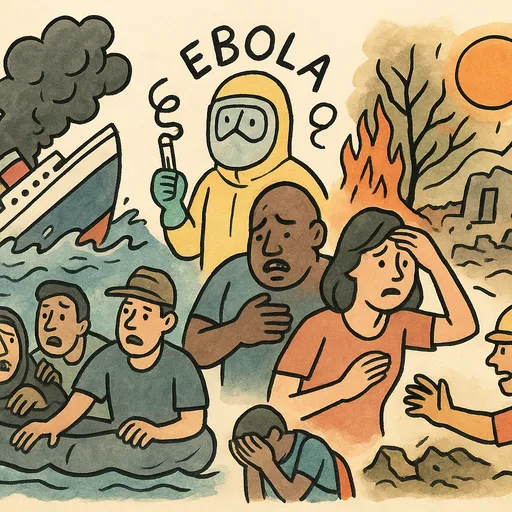
Recent reporting across regions highlights a surge in sudden disasters — notably deadly ferry and boat sinkings, migrant shipwrecks, and severe weather events — that have stretched search-and-rescue and relief operations. A fast-moving Ebola epidemic in eastern DR Congo and localized disease outbreaks in crowded displacement settings are compounding public health emergencies and prompting international vigilance. Major earthquakes in Venezuela and Peru prompted large-scale rescue, identification and international aid missions, while European wildfires and heatwaves strained firefighting and funeral services. Governments, international agencies and NGOs are mounting varied responses: emergency evacuations, repatriations, cross-border aid deliveries, preparedness drills and investments to bolster resilience ahead of more storms and climatic threats.
Regional and international outlets focus on the ferry capsizing off Guyana, reporting on mounting death tolls, ongoing search-and-rescue operations and investigations into safety and manifest irregularities. Neighboring states and global media highlight condolences, criminal probes and the wider challenges of maritime safety in the region.
Reports from African and Pacific sources emphasize recurring deadly boat sinkings and missing migrants, stressing the humanitarian scale and the perilous nature of sea crossings. Coverage calls for stronger regional cooperation, search resources and safer migration pathways.
Health-focused outlets and regional sources report rapidly rising Ebola cases and deaths in eastern DR Congo, with WHO warnings about unprecedented spread and calls for intensified vaccination and surveillance. The cluster also captures precautionary medical evacuations and the international public-health community’s heightened response.
Regional and international coverage highlights catastrophic earthquake impacts in Venezuela and neighbouring states, documenting high death tolls, rescue efforts and a patchwork of international aid missions. Stories emphasize diplomatic implications of foreign relief contributions and the logistical challenges of recovery and victim identification.
European reporting focuses on extensive wildfires, mass evacuations and the toll of heatwaves on emergency services and mortuary capacity. Narratives stress resource-intensive firefighting operations, cross-border cooperation, and climate-driven increases in extreme fire risk.
Meteorological and local sources cover intensified storms, flooding and landslides from the Caribbean and U.S. Gulf Coast to Chile, Afghanistan and China, underlining disruptions, casualties and isolation of communities. Reports highlight how weather conditions impede search operations and emphasize the need for preparedness.
Multiple outlets report tunnel blasts and collapses in India with fatalities and many missing, concentrating on rescue efforts, investigations into causes and concerns about construction safety. The perspective is urgent and investigative, focusing on emergency response coordination.
Coverage from Asia and Africa details deadly bus fires and school transport crashes, spotlighting rescue operations, casualty counts and renewed scrutiny of road and vehicle safety standards. Reports call for inquiries and improved regulation to prevent repeat tragedies.
Reports on crowded refugee camps and preparedness initiatives stress disease outbreaks in displacement contexts (e.g., chickenpox in Gaza) alongside investments in readiness such as Red Cross reorganizations, simulated typhoon drills and EU resilience funding. The angle highlights both acute needs and efforts to strengthen local response capacity.
U.S. and international reporting frames recent aid flights and packages to Cuba as humanitarian relief for affected populations while noting the political context and diplomatic sensitivities. Coverage underscores continued assistance despite strained bilateral relations.
Environmental and health stories cover mass fish kills, marine debris efforts, large-scale livestock disease losses and outbreaks like hantavirus, highlighting ecological and food-security impacts as well as long-term mitigation needs. The perspective connects environmental degradation and disease risks to livelihoods and public health.
Coverage of conflict-affected areas underlines how wars and economic shocks (e.g., Iran war impacts, Yemen price crises, Sudan fighting) deepen humanitarian need and impede assistance. Reports call for urgent relief, protection of civilians and international support.
Domestic reporting documents deadly stampedes, foster-home fires and other fatal incidents, with an emphasis on emergency response, investigations and accountability for safety standards. The perspective is often local and investigative, seeking causes and lessons.
Human-interest coverage spotlights extraordinary individual survival stories and localized rescues that offer hope amid larger disasters, emphasizing resilience and immediate lifesaving actions by responders or survivors themselves.
Reporting on a major offshore earthquake in Mexico focuses on strong shaking, tsunami warnings and rapid government monitoring, reflecting the acute risk-management and early-warning perspective in seismic-prone areas.