
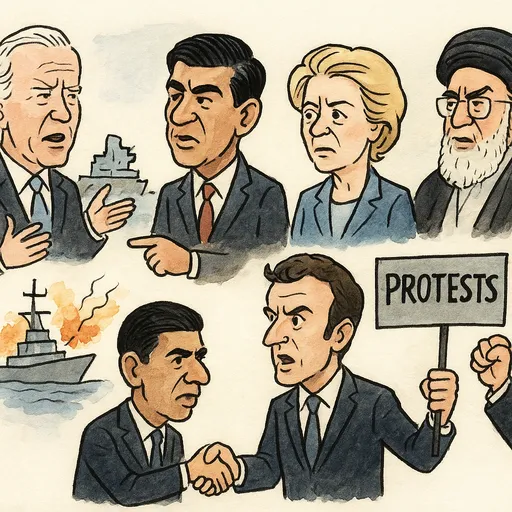
World leaders and senior officials are conducting intensive bilateral and multilateral talks to manage rising security flashpoints and preserve alliances. In the Indo‑Pacific, U.S. condemnation of Chinese maritime actions and ASEAN deliberations underscore regional anxiety about escalation and the need for restraint. The UK leadership transition has prompted swift transatlantic and EU outreach while domestic protests and international optics test new policy stances. Simultaneously, planned high‑level engagements with Russia and North Korea, Gulf coordination amid U.S.–Iran tensions, France’s protests over detained diplomats in Tehran, and pushes for European defence production and multilateral peacebuilding show leaders juggling deterrence, diplomacy and institution‑building.
Sources stress maritime security, allied responses, and ASEAN’s role as the primary diplomatic forum to prevent escalation. The U.S. and regional actors call for restraint after confrontations in the South China Sea while Southeast Asian states weigh balanced approaches to great‑power rivalry.
Coverage highlights Prime Minister Andy Burnham’s rapid diplomatic outreach to reassure the United States and engage the EU, with global leaders and China offering formal congratulations. Domestic protests over Middle East policy and high‑profile encounters with U.S. figures illustrate how the new government’s foreign policy is being publicly tested.
Reports emphasize cautious re‑engagement and high‑level contact as Washington and Moscow explore limited channels, marked by a planned visit by the U.S. FBI director. Parallel diplomatic outreach between Russia and North Korea signals continued strategic alignment and backchannel diplomacy in a tense great‑power environment.
France frames Tehran’s detention and intimidation of embassy staff as an unacceptable breach of diplomatic norms and has formally protested, warning of repercussions. Paris’ stance underscores rising tensions between European capitals and Iran over the safety and treatment of foreign mission personnel.
Regional governments are coordinating responses to spillovers from U.S.–Iran hostilities while pursuing bilateral paths to de‑escalation and border stabilization. Egypt, Qatar, Saudi Arabia, Jordan and Iraq are engaged in consultations on maritime security, conflict containment and confidence‑building, with Lebanon‑Israel talks and Lebanese troop movements cited as part of diplomatic outcomes.
European leaders debate bolstering collective defence industrial capacity and strategic autonomy, including plans to mass‑produce drones and new weaponry. That drive coexists with internal political debates over coalition action, relations with Turkey, and public skepticism about purely rhetorical coalitions.
States and international organizations are advancing institutional and soft‑power responses — from peacebuilding funds to UN leadership campaigns and faith and youth diplomacy. These initiatives seek long‑term confidence building and cross‑regional cooperation alongside security‑focused talks.
Regional leaders are converging on ceremonial and political milestones — notably Peru’s incoming administration — which serve as venues for diplomacy, reconciliation messaging and signaling from neighbours. U.S. commentary and opposition figures also continue shaping narratives about transitions in the region.
U.S. officials allege Cuban espionage and infiltration activities while critics question U.S. policy framing and historical context. The exchange mixes security allegations with political and historical contestation about bilateral relations.
Beijing signals willingness to engage at the highest levels — including a planned Xi visit to the U.S. and public support for multilateral institutions — even as competition with other powers remains acute. Coverage frames China’s outreach as both a bid to stabilize ties and a projection of global influence.