

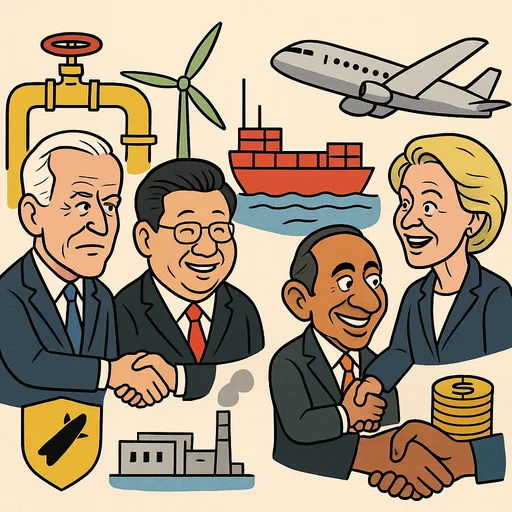
This set of reports shows a global uptick in bilateral agreements spanning defence procurement, energy and infrastructure projects, trade pacts, and development assistance. Governments and firms are negotiating arms purchases and security cooperation while also pushing connectivity and investment deals—from semiconductor plants and maritime accords to aviation links and pipeline steps. China’s outreach across regions and competing partnerships in the Pacific, Africa and Central Asia appear alongside Western-led defence and trade alignments, as countries balance economic opportunity with strategic concerns. Several stories also highlight diplomatic follow-through—state visits, high-level meetings and symbolic gestures—that underpin formal signings and implementation plans.
South Korean reporting highlights regional competition for advanced manufacturing and aerospace contracts, emphasizing speed and capacity in semiconductors and aircraft markets. The perspective stresses how industrial strategy and supply-chain limits shape bilateral investment races and global procurement.
Azerbaijani items show an outreach focused on deepening economic ties with Germany, expanding regional trade links and improving security interoperability through training and connectivity. The reporting frames bilateral engagement as part of a broader strategy to attract investment and strengthen regional logistics and defence capacities.
Ambassadors praised Ethiopia’s reform trajectory and outlined multi‑pillar approaches—governmental, private, NGO and people‑to‑people—to expand cooperation. The view highlights targeted investment interests in agriculture, water, health and digital development.
Coverage emphasizes Ankara–Doha coordination on regional security, energy and diplomatic cooperation following ministerial talks. The perspective frames Qatar as an active partner in Turkey’s regional engagement and security diplomacy.
Reports on Ukraine underline deepening defence ties with Western partners focused on missile defence and more affordable interceptors to expand capability. The stance highlights operational cooperation as central to Kyiv’s security strategy.
The German-funded donation to Liberia stresses practical development assistance aimed at climate‑resilient rice production and logistical support for farmers. The narrative showcases bilateral development aid delivering operational capacity on the ground.
Reporting notes the Dutch government will decide on Curaçao’s reform funding timetable, signalling conditional bilateral fiscal oversight and support. The tone reflects careful donor assessment ahead of continued assistance.
Indonesian-sourced items frame recent deals and airshow dynamics around defence spending and procurement priorities. The emphasis is on modernizing capabilities amid regional security pressures and shifting exhibitor focus from commercial jets to weapons.
The single item highlights bilateral medical assistance, with Brazil supplying Venezuela vaccines as a form of health diplomacy and humanitarian cooperation. The perspective illustrates how vaccine shipments remain an element of interstate goodwill.
German reporting frames a surging UK–Germany security partnership, including secretive missile projects and broader strategic alignment. The perspective underscores tightening European defence collaboration in response to evolving threats.
Items flagged under this source highlight external partnerships in technology and trade—Germany’s IBM boost for quantum, an Australia–UK free trade deal and US efforts to ease EU trade friction. The perspective connects technology cooperation with trade policy as drivers of competitiveness.
Coverage indicates the EU extended preferential trade arrangements for Malawi and others, aiming to preserve market access and support exports. The view frames the extension as stabilizing trade relations for developing economies.
The piece records Guinea’s diplomatic request to France for the return of cultural artifacts, highlighting restitution as a bilateral and symbolic issue. It frames repatriation as a matter of national heritage and state-level negotiation.
Belarusian reporting emphasizes a new multimodal cargo route to Ghana as a strategic move to diversify trade with Africa and improve logistics. The perspective showcases infrastructure as a lever for bilateral commercial expansion.
Reporting highlights Syrian diplomatic outreach to Kuwait to bolster bilateral cooperation and follow up on regional developments. The perspective emphasizes normalization and pragmatic engagement in Gulf diplomacy.
Libyan items show parallel tracks: security contracts with Turkey, the resumption of US consular services in Benghazi, and strategic energy cooperation with Chevron. The coverage frames bilateral deals as central to Libya’s reconstruction and sovereignty challenges.
Taiwan’s financial commitment to Saint Lucia is presented as people‑centred development support, reinforcing Taipei’s diplomatic partnerships in the Caribbean. The perspective stresses targeted development assistance as a tool of bilateral relations.
Reports describe a historic EU–UK agreement resolving Gibraltar’s post‑Brexit arrangements, including border management and governance implications. The perspective frames the accord as a template for resolving complex bilateral transit and sovereignty issues.
A Syrian report reiterates Al‑Shaibani’s commitment to deepen ties with Kuwait, stressing trade, investment and regional security as cooperation areas. The piece highlights efforts at rapprochement and practical collaboration.
An Austrian‑sourced analysis offers a critical appraisal of Asma al‑Assad’s role in Syria’s regime and its ties to Moscow, framing personal networks as geopolitically consequential. The view emphasizes accountability and the regime’s external backing.
Egyptian coverage highlights bilateral outreach on security cooperation, regional health logistics and economic ties with Montenegro and Mozambique. The perspective shows Cairo pursuing diversified partnerships in both African and European spheres.
Georgian items underscore cross‑border investment activity—from Russian buyers into real estate to a major syndicated loan supporting green initiatives—and public signalling of stronger US ties. The perspective links finance, foreign demand and geopolitics in national development.
The coverage frames UK‑Somalia talks as focused on deepening military cooperation and capacity building for Somali security forces. The perspective underlines continued international support for stabilisation efforts.
Reporting highlights a US plan to implement pilot zones with Lebanon and Israel, presenting a US‑led diplomatic initiative to test localized security or governance arrangements. The view emphasizes experimental, mediator‑driven approaches to difficult bilateral issues.
The note frames the Israel–Lebanon ceasefire as having passed an initial practical trial, with phased steps and mediator oversight. The piece positions bilateral compliance and phased withdrawals as indicators of fragile but actionable de‑escalation.
The report presents a tourism partnership as enhancing Monaco’s global visibility and destination appeal through a private‑sector collaboration. The perspective views bilateral cultural and commercial ties as instruments for soft power and marketing.
Reports highlight an expanding US partnership on resilience and returns of cultural items, alongside Vietnam‑funded scholarships for Ni‑Vanuatu students. The perspective emphasizes multi‑faceted cooperation combining security, education and cultural diplomacy.
A brief notes the Kazakh president’s congratulatory message to Spain, reflecting routine diplomatic courtesy to sustain friendly bilateral ties. The piece underscores symbolic signalling in state‑to‑state relations.
Taiwan signals a review of economic ties after Papua New Guinea closed Taiwan’s office, indicating potential reassessment of trade and energy purchases. The perspective frames diplomatic rupture as carrying economic consequences.
The Guardian‑sourced allegation about UAE distribution of Pegasus spyware draws attention to the transfer of intrusive surveillance tools among allied states. The piece raises bilateral concerns over privacy, accountability and regional security implications.
Coverage of Tonga frames deepening China ties as part of Pacific development outreach, while analysis of Australia’s push suggests competing influence and sovereignty sensitivities. The perspective situates bilateral deals within a larger geopolitical contest in the Pacific.
UK reporting calls the initial constitutional negotiation round constructive, signaling continued engagement and phased talks on governance reforms. The perspective stresses iterative dialogue and clarity of territorial priorities.
China’s reaffirmation of Fiji as a key partner frames bilateral ties around trade, infrastructure and development investment. The view highlights Beijing’s prioritization of Pacific partnerships through state‑level commitments.
Reporting highlights efforts to strengthen cross‑border trade and transit, focusing on regulatory and infrastructure steps to facilitate economic partnership. The perspective emphasizes practical integration for mutual economic benefit.
Mauritanian coverage records a joint press conference with Germany and reports on a Nigeria–Morocco pipeline agreement signed in Freetown, indicating interest in both diplomatic engagement and regional energy projects. The perspective stresses cooperation to mobilize investment and infrastructure.
The Air Zimbabwe London service relaunch is presented as a connectivity milestone backed by state support, aimed at boosting travel and trade ties with the UK. The piece frames bilateral aviation links as economic and diplomatic enablers.
The Thailand–China pledge focuses on stamping out illicit financial flows while promoting quality, law‑abiding investment and cooperation in future industries. The view balances economic openness with regulatory safeguards.
China‑sourced coverage spotlights trade opportunities such as Kenyan tea exports and the pledge to deepen ties with Thailand, emphasizing market access and bilateral economic expansion. The perspective presents trade diplomacy as central to Beijing’s foreign engagements.
Reporting highlights the signing of 48 agreements between Iraq and the United States covering security, economic development and governance, framing the package as a comprehensive bilateral reset. The perspective emphasizes depth and scope in strategic cooperation.
Reports indicate Panama renewed a key treaty and struck a maritime agreement with China, signalling sustained diplomatic and shipping ties. The perspective notes practical implications for trade flows and regulatory treatment of vessels.
Two items stress Guinean company Sogefel’s role in building the ECOWAS logistics base in Sierra Leone, highlighting regional construction capacity and industry exportability. The perspective frames bilateral infrastructure projects as platforms for national expertise.
Reporting covers Australian support for police expansion programs, a landmark Saudi Fund financing agreement, and Australian‑backed leadership programs—together signaling diversified bilateral assistance for governance and infrastructure. The perspective shows multilateral bilateral engagement to build domestic capacities.
A local cultural tournament and a cooperation pact with an Italian town are presented as expressions of friendly cross‑border ties and people‑to‑people diplomacy. The perspective emphasizes soft, municipal-level bilateral relations.
Bulgarian‑sourced items note Portugal’s purchase of frigates from Italy and Zelenskiy’s gratitude to the new British PM for continued support, linking defence procurement and political backing. The perspective situates bilateral deals within broader European security dynamics.
Brunei coverage highlights defence dialogues with Thailand and the Sultan’s foreign visit, underscoring continuing military and diplomatic contacts. The perspective stresses ceremonial and defence ties as pillars of bilateral relations.
The Coordination Framework’s public support for Zaidi’s agreements with Washington frames certain domestic actors as endorsing strengthened Iraq–US ties. The piece notes internal political validation for external pacts.
Vatican‑sourced reporting frames the disappearance of border checks between Spain and Gibraltar as a practical outcome of the EU‑UK agreement, highlighting immediate gains for movement and trade. The perspective emphasizes regional integration benefits.
A Hong Kong analysis frames Europe’s trade posture toward China as contingent on how success is defined, stressing industrial protection and supply‑chain resilience. The perspective treats bilateral economic competition as strategic and policy‑driven.
Laotian reporting covers progress on the Luang Prabang hydro project with Thailand, trade fairs and cooperation with Vietnam, Russia, and Hong Kong—signalling active cross‑border economic and people‑to‑people diplomacy. The view highlights regional infrastructure and market integration.
The coverage describes Washington events marking Turkmenistan’s and US independence anniversaries, emphasizing ceremonial diplomacy and diaspora engagement. The perspective underscores soft‑power and symbolic bilateral ties.
Vietnamese reporting highlights Japan’s plans to develop nautical charts for Southeast Asian choke points and the resilience of China‑ASEAN trade, combining maritime safety cooperation with trade continuity. The perspective treats maritime cooperation and trade as complementary pillars of regional stability.
Angolan‑sourced coverage relays Beijing’s intent to protect Chinese interests after the UK nationalized British Steel, framing state responses as defensive measures in trade disputes. The view emphasizes reciprocal economic statecraft in bilateral commercial conflicts.
Taiwanese reporting relays Thai alarm over China’s tank deliveries to Cambodia, framing arms transfers as a destabilizing factor in bilateral and regional ties. The perspective emphasizes diplomatic appeals to manage security risks.
Tajik reporting highlights China as the country’s top trading partner and showcases symbolic gestures during a Mongolia state visit to signal friendship, reflecting a mix of pragmatic trade dependence and traditional diplomacy. The perspective stresses economic ties complemented by ceremonial diplomacy.