US–Iran exchanges escalate, threatening wider regional war
Middle East Conflict Escalation2026-07-21 • 156 articles in total
In brief
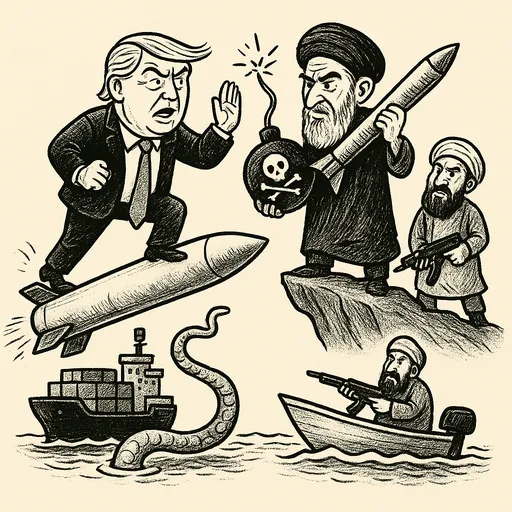
The U.S. and Iran are engaged in escalating airstrikes and missile attacks portraying a near full-scale war.
Iran-backed Houthis threaten maritime blockades disrupting key shipping routes in the Red Sea and Strait of Hormuz.
Regional states condemn Iranian aggression, strengthen defenses, and international efforts push for urgent de-escalation to avoid wider conflict.
A sustained campaign of U.S. airstrikes against Iranian targets across multiple consecutive nights has driven a sharp escalation in hostilities, prompted by the reported deaths of U.S. service members and public warnings from U.S. leaders. Iran and the IRGC have responded with missile and drone strikes on regional bases and infrastructure, and Iranian officials have framed the confrontation as a large- or full-scale war. Yemen’s Houthi movement and Iran-backed militias have announced naval blockades and attacks on shipping, threatening Red Sea and Strait of Hormuz routes and raising global energy and trade risks. International actors, mediators and analysts warn the conflict could spread further without urgent de‑escalation and ceasefire measures, as civilian infrastructure and regional allies are drawn into the fighting.
Countries covering this topic
U.S. and Western reportage: justification and operational updates
This cluster reflects outlets emphasizing U.S. military action, Trump-era rhetoric and Pentagon reporting—framing strikes as punitive, retaliatory or deterrent responses to attacks on American personnel and regional shipping. Articles focus on consecutive nights of strikes, deployments, casualty counts among U.S. forces, and official statements asserting operational objectives.
These pieces convey Iranian official and IRGC positions stressing retaliation, deterrence and the narrative that Iran faces or is engaged in a large/full-scale war with the United States. Coverage emphasizes Iranian missile and drone strikes, defensive claims (including intercepting incoming munitions), and warnings directed at U.S. forces and states hosting them.
Gulf states and regional governments: condemnations and defensive posture
Gulf and allied governments are portrayed as vulnerable states that condemn Iranian attacks while taking defensive measures to protect ports, shipping and territory; many call for restraint while bolstering air and naval defenses. These articles emphasize statements by the UAE, Bahrain, Kuwait and Saudi Arabia, and operational steps to protect merchant traffic and critical infrastructure.
This cluster captures Houthi declarations and Yemen-related developments portraying a new front in the crisis: maritime blockades and naval actions that threaten Red Sea and Gulf shipping. Reporting highlights Houthi threats and blockades, links to Iran-backed networks, and the risk of expanding the conflict into Yemen and key maritime chokepoints.
Local frontline coverage focuses on the simultaneous, related violence in Gaza, the West Bank and southern Lebanon—civilian casualties, settler violence, occupation markers and Lebanese security responses—underscoring how the wider regional war compounds existing Israeli–Palestinian and Israel–Lebanon tensions. These reports highlight local humanitarian impact and security shifts on land borders and contested zones.
International, UN and analyst concerns: shipping, energy and escalation risk
Independent and international outlets emphasize the broader implications: disrupted shipping and tanker attacks in the Strait of Hormuz and Red Sea, energy market risks, UN warnings about regional escalation, and analyst commentary on military readiness and strategic stalemate. This perspective stresses urgent diplomatic efforts, mediators' ceasefire proposals, and the humanitarian and economic fallout if fighting widens.