

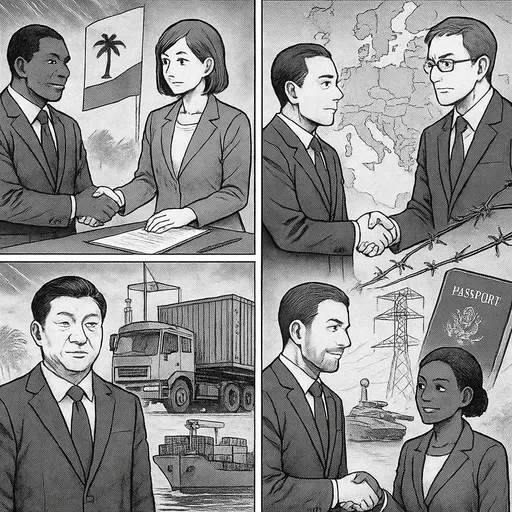
Recent bilateral deals and agreements show a tide of pragmatic diplomacy focused on connectivity, security and development. Caribbean and Kingdom-level accords concentrate on institutional alignment, air links and economic cooperation, while China’s outreach combines high-level diplomacy with major investment and infrastructure projects across Asia, Africa, Latin America and the Pacific. Europe and neighbouring states pursue practical measures on borders, visas and restitution, even as trade pacts and tariff easings advance between major partners. African, Pacific and Latin American states are signing targeted financing and technical partnerships, and defence and energy cooperation continues to feature prominently in regional stability agendas.
Kingdom and Caribbean actors emphasise institutional strengthening, sectoral cooperation and improved connectivity to boost resilience and economic ties. The perspective frames bilateral and intra-Kingdom deals as pragmatic steps to harmonise governance, expand air links, and support local entrepreneurs and tourism.
Chinese diplomacy combines high-level state visits and discreet logistical links with large-scale overseas investment projects to deepen influence and secure strategic partnerships. Beijing’s approach is presented as both political engagement (notably with North Korea) and economic statecraft in Latin America, Africa and beyond.
Laos positions itself as a partner seeking deeper economic, educational and technical links both with China and other partners such as India and South Korea. The country’s viewpoint stresses institutionalising cooperation, vocational and innovation exchanges, and converting diplomatic ties into practical development outcomes.
Regional leaders emphasise shifting from geopolitical narratives to concrete development and cross-border cooperation, while sensitive border-security measures remain contentious. Nepal and India focus on practical outcomes like transit, energy and digital payments, even as security and sovereignty debates persist.
Governments and trade officials present new free trade and easing measures as steps to boost jobs, investment and supply-chain resilience across allied partners. The outlook treats these pacts as pragmatic economic diplomacy intended to sustain growth amid wider geopolitical frictions.
Regional and international actors frame recent ceasefires and confidence-building measures as fragile but necessary mechanisms to manage escalation. The perspective highlights diplomatic mediation, ceasefire arrangements and infrastructure proposals that could alter trade and security dynamics.
States defend sovereignty-tinged arrangements and migration agreements amid criticism, while reports of territorial purchase options raise strategic and legal questions. Sources frame these disputes as pragmatic policy choices with reputational and humanitarian implications.
European actors emphasise rule-based, bureaucratic pathways to resolve border delineation, visa regimes and historical restitution without necessarily resorting to new treaties. The perspective reflects incremental diplomacy focused on technical solutions and legal processes.
States in the Southern Hemisphere focus on large infrastructure and connectivity projects to stimulate regional integration and economic development. The viewpoint highlights feasibility-stage proposals and humanitarian assistance as tools of bilateral cooperation.
African and partner-country sources present cooperation as a mix of investment invitations, strategic resource partnerships and capacity-building programmes. The emphasis is on attracting finance, technical transfers and diplomatic support to foster growth and regional stability.
Pacific island actors convey a focus on diversified funding and development options, welcoming Saudi, Australian and Chinese assistance while navigating great-power sensitivities. The perspective stresses practical benefits for infrastructure, training and transport connectivity.
States foreground defence and security ties, and practical energy or capability swaps, as essential components of bilateral relations that underpin regional stability. The viewpoint spans planned defence exports, military cooperation in Africa and cross-border energy sourcing discussions.
Libyan authorities and partners frame upcoming forums and bilateral talks as avenues to attract finance and strengthen technical and vocational education. The perspective presents Paris- and Cairo-based engagements as steps to rebuild linkages and capabilities.
Comorian officials and international partners present a development framework aligning UN support with national priorities, while other partners stress delivery on pledges and projects. The viewpoint emphasises governance, implementation and multilateral-bilateral complementarity.
Regional partners publicly reaffirm support for Syria’s sovereignty and explore expanded cooperation despite complex geopolitics. The perspective frames bilateral meetings as part of Syria’s gradual reintegration into targeted diplomatic channels.
Cultural exchanges and visits serve as soft-power tools to strengthen bilateral relations, highlight shared heritage and expand cooperation in education and Francophonie frameworks. Officials frame such visits as complementary to formal diplomatic and economic ties.
Bilateral conversations on constitutional reform and governance are portrayed as mutually reinforcing steps to stabilise institutions and align policy frameworks. The single-article perspective underlines technical assistance and dialogue as key instruments.
Governments and city-level actors stress visa waivers and sister-city initiatives as pragmatic ways to boost tourism, exchanges and municipal cooperation despite broader geopolitical tensions. The emphasis is on lowering barriers to travel and increasing direct contacts.