
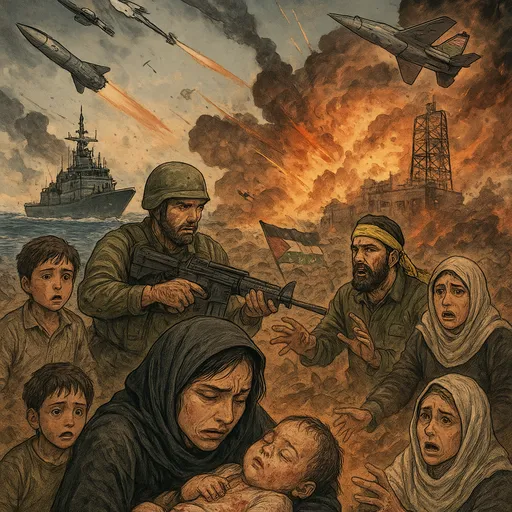
Fighting spread on multiple fronts as exchanges between the United States and Iran in the Gulf — including drone and missile launches, interdictions and strikes on radar sites — tested a fragile ceasefire and threatened shipping lanes. Along the Levant, intensive Israeli strikes and cross-border exchanges with Hezbollah have killed Lebanese soldiers and civilians, while Hezbollah and other Lebanese actors rejected ceasefire terms. In the occupied territories and Gaza, repeated Israeli operations produced high civilian tolls, including infants and many fatalities in Gaza, prompting rights concerns and denunciations of military doctrines. Gulf and Arab states condemned attacks on Kuwait and Bahrain and called for de-escalation, even as regional and covert dynamics (secret deployments, intelligence operations and societal fear) complicated diplomatic efforts and raised the risk of wider regional conflagration.
Sources reflecting Iranian actions or focus frame strikes, missile and drone launches as retaliation for U.S. attacks and as a deterrent against foreign use of neighboring territory. Tehran issues warnings to neighbors, signals readiness to widen the conflict if pressed, and emphasizes strikes on Gulf targets and U.S. positions as justified responses.
Western and U.S.-aligned reporting stresses protective and deterrent actions — shooting down Iranian drones, striking radar sites and responding to threats to shipping lanes. The narrative emphasizes measured military responses intended to secure maritime traffic and allies while warning of the risk of further escalation.
Coverage tied to the Israel–Lebanon theatre highlights intensive Israeli strikes on Hezbollah positions and Lebanese territory, the killing of Lebanese soldiers and officers, and Lebanese political denunciations of sovereignty violations. Hezbollah’s rejection of disarmament and ceasefire terms and Israeli statements about continuing operations portray a confrontation that undermines ceasefire durability.
Reports from Palestinian and Gaza-focused sources emphasize civilian suffering from Israeli strikes, documenting high death tolls in Gaza and deaths of infants and families in the West Bank and Hebron. Coverage often frames attacks as unlawful or disproportionate, highlights humanitarian distress, and criticizes doctrines and tactics used by Israeli forces.
Gulf governments and other Arab actors stress the danger of attacks on Kuwait and Bahrain, denounce perceived Iranian aggression, and call for international support and restraint. Regional statements focus on intercepts, airspace and airport closures, and diplomatic pressure to prevent further escalation.
Analytical and investigative pieces highlight covert deployments, intelligence-driven actions, broader geopolitical networks and the social consequences of prolonged conflict, including displacement, suspicion and civilian anxiety. This perspective stresses opaque operations, secret ties across the region and the humanitarian and economic spillovers that complicate diplomacy.