
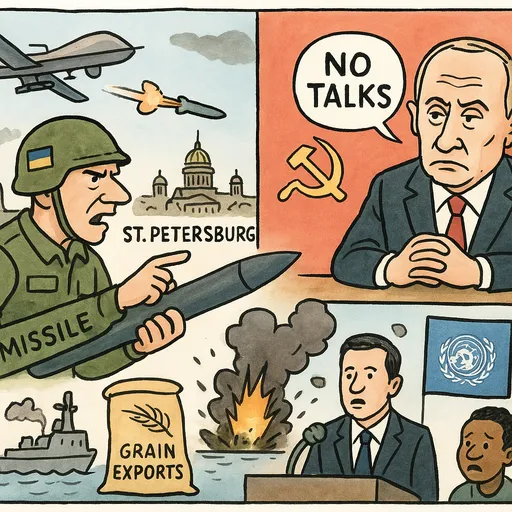
The reporting shows a marked military escalation: Ukraine has mounted long‑range drone and missile strikes into Russian territory (including St. Petersburg and oil terminals) while Russia continues heavy aerial and missile campaigns across Ukraine. Diplomatic efforts at the highest level are stalled as Vladimir Putin repeatedly rejects Zelensky’s outreach and conditions talks on Russian objectives, even as limited humanitarian exchanges such as prisoner swaps continue. The conflict is producing regional spillovers — maritime incidents, a drone explosion near Romania, disrupted grain exports affecting African food security, and dangers to international shipping. International bodies and legislatures are reacting: the UN Security Council convened emergency meetings and some parliaments continue to back Ukraine, while analysts warn of wider NATO and economic implications. Domestic messaging from Moscow focuses on economic resilience and justification for continued military action, while Kyiv frames strikes as part of an approved strategic plan to degrade Russia’s war capacity.
Romanian coverage frames the Constanța drone explosion and related incidents as direct consequences of Russia’s war and a threat to neighboring countries. Reports stress regional security implications and note NATO and EU concern about escalation beyond Ukraine.
South African reporting links the conflict to global food security, highlighting stolen Ukrainian grain and its impact on African markets. The piece calls for coordinated relief and policy responses to protect continental food supplies.
Bulgarian coverage emphasizes the reach of Ukraine’s drone campaign into Russian industrial targets, reporting a strike that caused a fire in Saint Petersburg. The perspective underscores the conflict’s cross‑border military consequences.
Cypriot reporting highlights a surge in long‑range Ukrainian drone activity against Russian cities and the high number of intercepts near Saint Petersburg and Moscow. The angle stresses the intensifying aerial dimension of the war.
Moldovan pieces combine diplomatic bleakness — Putin refusing a meeting — with live battlefield updates about strikes and Russian attacks on Donetsk. The reporting conveys both the diplomatic impasse and the human cost on the front lines.
Beninese reporting relays Putin’s dismissal of Zelensky’s open letter as ‘crude’, reflecting Moscow’s rejection of Kyiv’s overtures. The piece captures Russia’s firm rhetorical posture toward proposed talks.
Latvian coverage reports large Russian attacks using missiles and drones and emphasizes damage and the risk of escalation. The perspective focuses on the immediate military threat to Ukraine.
Panamanian pieces summarize Putin’s claims about Russia’s economic resilience under sanctions and his insistence that any talks require Ukrainian withdrawal from Donbas. The reporting highlights Moscow’s conditions and public messaging strategy.
Uzbek reporting notes drone attacks on Saint Petersburg coinciding with the St. Petersburg International Economic Forum, framing them as both military actions and politically timed disruptions. The angle underscores risks to Russia’s economic diplomacy.
Austrian coverage highlights Putin’s refusal of Zelensky’s meeting and frames it as hardening Russia’s stance. The piece underlines the diplomatic deadlock.
Egyptian reporting emphasizes Russia’s escalation of aerial attacks as it struggles on the ground, stressing increased use of drones and missiles. The perspective focuses on battlefield tactics and civilian impacts.
Articles from the Faroes examine claims about drone effectiveness, heavy attacks on Kyiv, and Russia’s plans to strengthen air defenses. The coverage highlights both vulnerabilities and military adaptation by the belligerents.
Greenland‑sourced coverage reports a U.S. House vote supporting Ukraine, reflecting ongoing Western legislative backing. The piece signals continued political support in allied capitals.
Georgian reporting quotes Lavrov accusing the West of trying to pull Georgia away from Russia, illustrating Moscow’s narrative of Western interference in its neighborhood. The angle reinforces Russian concerns about regional alignment.
Estonian coverage provides granular battlefield updates (sea drone losses, strikes) and tracks Putin’s statements as well as Zelensky’s open letter and diplomatic signals. The perspective combines security reporting with analysis of rhetoric and negotiation prospects.
Greek reports cover humanitarian prisoner exchanges and a violent incident involving a Turkish fishing boat off Crimea, highlighting human cost and maritime insecurity in the Black Sea. The angle stresses regional safety and legal ramifications.
Finnish pieces range from IAEA‑reported incidents near Zaporizhzhia to commentary on Putin’s rude dismissal of Zelensky and analysis of battlefield admissions about strikes on Russian ports. The reporting balances nuclear safety concerns, diplomatic tone, and military developments.
Kazakh reporting focuses on the deaths of Azerbaijani citizens in drone attacks on ships in the Azov Sea, underlining dangers to international seafarers and commercial traffic. The perspective stresses cross‑border civilian vulnerability.
Montenegrin coverage relays Ukrainian statements about striking ships and acknowledges Putin’s messaging on economic actions like asset freezing and currency confidence. The reporting juxtaposes battlefield claims with geopolitical economic narratives.
Peruvian reporting quotes Putin saying there is no point in meeting Zelensky and ordering Russian forces to advance, stressing Moscow’s continued commitment to military objectives. The angle highlights the diminished near‑term prospects for negotiation.
Reporting from the Dominican Republic reiterates Putin’s statement that an imminent meeting with Zelensky is ruled out, reflecting global attention to the stalled diplomacy. The piece frames the situation as a continued stalemate.
Italian live coverage mixes Putin’s engagements (e.g., meeting Schröder) with criticism of Zelensky and ongoing military developments, portraying a fluid news cycle of diplomacy and conflict. The perspective emphasizes the interplay between statements and strikes.
French reporting highlights the interception of dozens of drones near Saint Petersburg, Putin’s rejection of Zelensky’s outreach, and Ukraine’s domestic de‑Russification actions like toppling contested statues. The angle captures both military escalation and social‑political consequences in Ukraine.
South Korean reporting stresses the strategic significance of Ukrainian long‑range drones striking an oil terminal in St. Petersburg during a major economic forum, underlining both military reach and economic symbolism. The perspective notes the timing’s diplomatic and investor risks.
Azerbaijani coverage relays Putin’s accusations of unfair Western competition, situating Russia’s grievance‑driven rhetoric within broader geopolitical contestation. The piece reflects Moscow’s attempts to shape an international narrative.
Gabonese reporting uses the death of a Nigerian student to examine Russian tactics and the risks facing foreign volunteers in Ukraine. The angle raises questions about recruitment, battlefield methods, and legal protections for fighters.
Haitian coverage paraphrases the Kremlin saying it is premature to discuss concrete endgame details, echoing Moscow’s guarded messaging even as speculation about an approach to the war’s end circulates. The piece captures uncertainty about timelines and terms.
North Macedonian reporting highlights heavy Russian attacks on Ukrainian cities with significant civilian casualties and injuries, underscoring the human cost of the campaign. The perspective emphasizes emergency response and aid needs.
Slovak reporting suggests Putin faces constraints as the war stalls and notes local shortages in Crimea such as gasoline disruption. The coverage stresses both political pressure on Moscow and practical civilian consequences in occupied areas.
Ukrainian pieces emphasize massive Russian attacks, calls for UN emergency sessions, and Kyiv’s framing of strikes on Russian infrastructure as part of an approved strategic plan. The viewpoint seeks international accountability while justifying offensive actions to degrade Russia’s warfighting capacity.
German reporting covers a Ukrainian apology over an explosive device found near Greece, Putin’s speeches on the economy, and his refusal to meet Zelensky — combining spillover incidents with Moscow’s messaging and diplomatic stalemate. The angle balances regional incidents and strategic rhetoric.
Lithuanian coverage highlights visually striking attacks on Russian naval assets and political messaging where Zelensky is said to have challenged Putin. The perspective underscores Eastern European sensitivity to military successes against Russia.
Norwegian reporting focuses on fatalities caused by Russian attacks in Kherson, underlining tragic civilian losses and humanitarian concerns. The angle calls attention to wartime suffering.
Icelandic pieces relay Putin’s statements that the war will not end until Russia achieves its objectives and his framing of only two options for the situation. The coverage reflects Moscow’s uncompromising public posture.
Nigerian reporting notes that Russian strikes killed dozens in Ukraine, emphasizing the scale of civilian casualties. The piece situates the violence within broader humanitarian concerns.
Chinese state reporting paraphrases Putin saying he sees no point in a personal meeting with Zelensky, conveying the Kremlin’s public stance through official channels. The piece reflects state media transmission of Russian messaging.
Coverage from Cambodia frames Putin’s forthcoming speech on a fragile Russian economy under threat from Ukrainian drones, noting domestic policy challenges and reputational risks. The angle highlights internal economic pressures intersecting with security threats.
Paraguayan reporting relays Putin’s mocking of claims that Trump ‘educated’ Zelensky on manners and style, showcasing Moscow’s use of rhetoric to undercut Western narratives. The piece focuses on persona and propaganda aspects.
Slovenian commentary contrasts subtle Western concerns about Russian interference with instances of overt brutality and describes Putin’s cool response to Zelensky’s open letter. The perspective melds analysis of influence operations with reporting on diplomatic posture.
Canadian reporting highlights Putin’s rejection of Zelensky’s negotiation offer and frames it as reducing prospects for a near‑term diplomatic breakthrough. The piece reflects western media concern over stalled diplomacy.
Angolan coverage quotes analysts warning that Ukrainian actions toward Belarus could have political repercussions for Kyiv, pointing to risky regional dynamics. The article highlights concerns about broader destabilization.
Hungarian reporting brings together British military analysis of Russian escalation, speculation about a possible Zelensky visit to Budapest, and Ukraine’s admission that one of its drones caused an explosion in Romania. The angle combines security analysis, diplomacy, and regional accountability.
Maldivian reporting summarizes ongoing developments between Putin and Zelensky, offering a concise overview of diplomatic and military moves. The piece presents the conflict as the dominant international story.
Jordanian reporting emphasizes Ukrainian drone strikes on St. Petersburg coinciding with a major economic forum, stressing security and the political symbolism of such timing. The angle highlights potential consequences for international engagement with Russia.
Serbian reporting relays Ukraine’s claim (with video) of striking a Russian drone‑launching center, treating battlefield footage as part of information warfare. The perspective notes the difficulty of independent verification but conveys Kyiv’s assertions.
Swiss coverage records Putin ordering military responses to provocations and investigates the sinking of a Russian‑linked ship off Spain, blending analysis of Moscow’s military posture with maritime intrigue. The angle connects military rhetoric with concrete incidents at sea.
Iraqi reporting notes the approaching 200‑day mark of the conflict and carries Putin’s conflicting economic statements, presenting both timeline context and Kremlin economic narratives. The piece situates the war in temporal and economic frames.
Polish coverage focuses on the personal toll of war through the experiences of Ukrainian veterans, highlighting rehabilitation and societal costs. The perspective centers human rather than strategic consequences.
Afghan reporting describes Russian drone and missile attacks killing civilians in Ukraine, underscoring continued lethal strikes and humanitarian fallout. The piece frames the violence as part of warning signs for possible larger offensives.
Hong Kong reporting quotes UK opposition leader Keir Starmer warning Russia could attack NATO within years, using the Ukraine war to spotlight wider security risks and urging stronger deterrence. The angle emphasizes strategic alarm among Western politicians.
Czech reporting highlights diminishing Russian bases in the South Caucasus and the provision of commercial real‑time satellite data to Ukrainian soldiers, showing both geopolitical shifts and the modernisation of Kyiv’s battlefield intelligence. The perspective links regional politics with new forms of military support.