

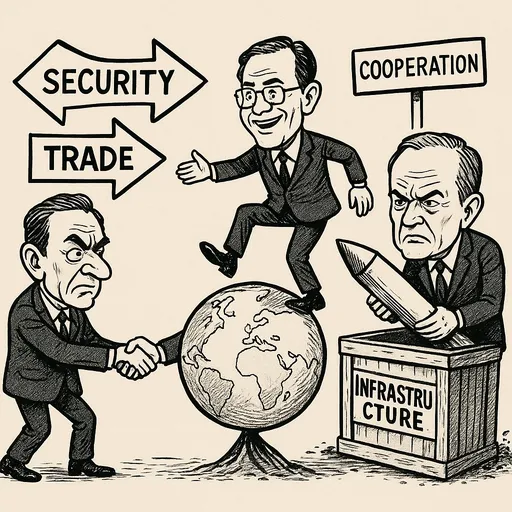
Across regions, governments signed a wide range of bilateral agreements covering security, infrastructure, trade, energy, and development financing while also expanding people-to-people ties through scholarships, cultural exchanges and private investment. Several defense and security pacts, arms sales and cooperative training programs underscore a continuing emphasis on regional stability and interoperability, even as ceasefires and fragile accords show persistent volatility at contested borders. Economic cooperation and infrastructure projects — from industrial parks and energy plants to trade roadmaps and investment forums — feature prominently as states pursue growth and connectivity, often backed by external partners. At the same time, public opposition and diplomatic rows over projects or political statements reveal domestic sensitivities that can complicate externally driven deals. Overall, the coverage shows an active phase of bilateral diplomacy combining pragmatic deals with cautionary friction on social and strategic fronts.
Australia frames its bilateral engagement with Solomon Islands around security and capacity-building, funding police expansion, construction leadership programs, and broader infrastructure support. The perspective emphasizes sustained Australian investment to strengthen governance, public safety and workforce skills in the Pacific nation.
Solomon Islands presents the Saudi Fund agreement as a landmark development partnership aimed at accelerating infrastructure and community projects. The government positions the deal as diversifying development partners and mobilizing financing for priority sectors.
San Marino highlights humanitarian and sporting-donation ties by dispatching goods to Congo in memory of Father Marcellino, portraying bilateral charity and soft-power connections. The narrative stresses continuity of charitable ties and people-to-people solidarity.
Suriname emphasizes substantive cooperation with Brazil across safety, infrastructure, trade, agriculture and energy, framing the accords as concrete steps toward development. Diplomatic engagement with Belgium is presented as a bid to broaden political and economic ties in Europe.
Romanian sources foreground tensions with China over cross-strait statements and record diplomatic rows with neighbors over border rhetoric, highlighting how external and neighbourhood disputes shape bilateral ties. The reporting frames these incidents as strains on Romania’s broader diplomatic environment.
Madagascar emphasizes renewed defense collaboration with France through agreements intended to tighten military cooperation and regional security coordination. The government frames such ties as part of long-standing strategic partnership and capacity building.
Beninese reporting highlights a joint Benin–Niger expert committee and a timebound effort to set conditions for border reopening, stressing collaborative, technical diplomacy to manage cross-border flows. The perspective underscores pragmatic regional problem-solving under tight deadlines.
IDB-backed institutions present the Private Sector Forum as a vehicle to boost investment and cross-border trade among member countries, underlining multilateral-bilateral interfaces that mobilize private capital. The perspective is one of institutional cooperation to foster regional economic integration.
Latvian-sourced reporting emphasizes a local ceasefire near Zaporizhzhia as an operational, fragile agreement intended to reduce nuclear-site risks and enable evacuations. The viewpoint stresses monitoring and conditionality as key to any durable pause.
Coverage frames the meeting between Niger’s president and the Algerian prime minister as a reinforcement of bilateral energy cooperation, showcasing regionally significant infrastructure projects such as a power plant. The emphasis is on energy security and pragmatic regional ties.
Ivorian officials present plans to deepen exchanges with Italy in technology and scientific research as strategic investments in innovation capacity. The perspective links bilateral science cooperation to national development priorities and modernization.
Japanese reporting highlights an upcoming prime ministerial visit to India as an important bilateral engagement likely to address regional and strategic issues, presenting the trip as continuity in high-level diplomacy. The story frames the visit as symbolically significant despite limited public agenda detail.
The Chinese ambassador’s office in Colombo frames China–Sri Lanka cooperation on cybercrime and telecom fraud as a shared security priority requiring intensified measures and coordination. The tone emphasizes law enforcement cooperation and mutual concern over cross-border digital crimes.
Reporting from the Israel/Lebanon context stresses U.S.-mediated efforts to secure ceasefires, framing agreements as contingent on third-party actors (notably Hezbollah) halting hostilities. The perspective highlights conditional ceasefires and the fragility of arrangements dependent on non-state compliance.
Ukrainian reporting underscores use of formal diplomatic channels to press bilateral concerns with Greece, signaling active diplomacy amid broader conflict-related foreign-policy management. The perspective presents Kyiv as proactively managing disputes through official notes.
Austrian reporting emphasizes that inflammatory rhetoric between Slovakia and Hungary undermines regional stability and urges tempering of public exchanges. The viewpoint privileges dialogue and restraint as prerequisites for healthy bilateral ties.
Kuwaiti sources frame the expulsion of Iranian diplomats as a firm diplomatic response to attacks on civilian infrastructure, signaling readiness to take decisive measures on security grounds. The account stresses state sovereignty and regional security consequences.
Egyptian coverage presents a strategic framework with Japan to advance economic cooperation and promote the Suez Canal industrial zone as central to securing supply chains. The emphasis is on attracting investment, technology transfer, and industrial development.
Faroe Islands reporting notes parliamentary approval of assistance to Ukraine, highlighting parliamentary mechanisms for approving international support and targeted aid benefits. The stance is aligned with broader Western support for Kyiv.
EU-leaning reporting advocates intensifying cooperation with Greenland, framing the relationship as strategically important for Arctic governance and mutual interests. The perspective calls for deeper institutional engagement.
Andorran sources outline pending border delimitation talks with Spain, negotiations with Catalonia on a tax model, and debates about diplomatic capacity and EU alignment. The perspective stresses small-state diplomacy balancing local constraints and aspirations for closer EU ties.
Grenadian reporting frames talks with Canada as efforts to bolster health systems, sustainable energy and skills development, highlighting a cooperative development agenda. The viewpoint emphasizes capacity building and resilience through bilateral engagement.
Estonian-sourced coverage relays Azerbaijan’s categorical denial of hosting Israeli military operations, reflecting sensitivity around third-party security allegations and state reputational concerns. The perspective centers on sovereignty and diplomatic clarification.
Iranian and Pakistani officials underscore the need for continuing diplomatic dialogue to secure durable peace, framing bilateral engagement as central to regional stability. The perspective promotes sustained talks and cooperation on shared security issues.
Officials describe a bilateral summit as making significant progress on CBCS governance, leadership nominations and financial oversight reforms to strengthen cross-border monetary integration. The viewpoint prioritizes institutional reform and cooperative financial management.
Island-level sources portray the letter of intent as a commitment to formalize youth participation policies across jurisdictions, stressing regional solidarity and inclusive governance. The perspective treats youth engagement as a policy priority for long-term resilience.
Serbian outreach frames scholarship offers as efforts to deepen educational and cultural ties, expanding soft-power channels and people-to-people exchanges with Vanuatu. The perspective emphasizes opportunity and exchange as tools of diplomacy.
Japan-hosted training is presented as capacity building for school disaster preparedness in Vanuatu, showcasing technical cooperation and resilience-enhancing bilateral programming. The narrative highlights practical knowledge transfer and regional preparedness.
Botswanan reporting blames production delays abroad (BVI) for multimillion-dollar export losses, stressing vulnerabilities from external supply-chain disruptions. The perspective calls attention to the economic costs of cross-jurisdictional operational issues.
Kazakh reporting highlights a proposal to develop a Cyprus economic roadmap, a presidential welcome for the Cypriot president, and resumed flights to the UAE, all indicating a push for diversified economic ties and connectivity. The viewpoint seeks to expand trade, investment and transport links.
Fijian authorities underscore environmental and regulatory concerns in rejecting an Australian billionaire-backed incinerator and port project in a tourism hotspot, projecting a precautionary approach to foreign investment. The stance emphasizes environmental protection and community interests.
Montenegrin coverage frames the Israel–Lebanon ceasefire renewal as fragile and contested, noting Hezbollah’s rejection and the risk of renewed clashes despite diplomatic progress. The perspective stresses the limits of bilateral agreements in complex conflict environments.
New Zealand-focused reporting describes U.S. approval of a $1.5 billion maritime helicopter sale as strengthening the country’s maritime defense capabilities and interoperability with partners. The angle underscores allied defense cooperation.
Sources stress Xi Jinping’s rare visit to North Korea as a sign of warming ties and a significant diplomatic event with security and regional implications. The perspective frames the trip as a high-profile bilateral engagement shaping East Asian dynamics.
Multiple entries treat conditional ceasefires between Lebanon and Israel as tentative, often mediated by outside parties and threatened by rejection from armed groups. The perspective stresses conditionality, pilot mechanisms and the precariousness of peace arrangements.
Thai reporting balances soft-power tourism outreach to Nepal with assertive border management operations, including repatriation of Cambodian nationals. The perspective blends promotional diplomacy with strict migration enforcement.
Official statements from leaders frame the Australia–New Zealand relationship as enduring and not to be taken for granted, emphasizing continuous high-level dialogue and shared values. The viewpoint stresses maintenance of the close bilateral partnership.
Chinese and host-country reporting frames a planned Chinese vehicle factory in Latin America as part of Beijing’s strategy to expand manufacturing footprints and regional market share. The angle emphasizes industrial diplomacy and economic influence.
Lebanese reporting highlights domestic opposition (notably Hezbollah’s rejection) to Lebanon–Israel agreements and sees implementation challenges rooted in internal political divisions. The viewpoint emphasizes how domestic actors shape the fate of bilateral deals.
Local reporting documents street protests against the opening of an Israeli embassy in Fiji, reflecting public solidarity with Palestinians and domestic resistance to foreign diplomatic moves. The perspective stresses civil-society reactions shaping bilateral decisions.
Russian sources present denials of weapons transfers to Iran, framing statements as rebuttals to regional allegations and as efforts to manage diplomatic perceptions. The angle seeks to defuse attribution and maintain strategic relationships.
Chinese coverage frames zero-tariff treatment on African coffee as improving affordability and diversity for Chinese consumers while boosting Africa–China trade ties. The perspective presents tariff policy as mutually beneficial economic diplomacy.
Colombian reporting presents a shipment of aid to Cuba as an expression of bilateral solidarity aimed at addressing urgent humanitarian needs. The perspective stresses practical assistance and regional cooperation.
Russian accounts highlight business interest in Cuba and high-level Cuban participation in economic dialogues, portraying Cuba as an attractive destination for investment in tourism and technology. The viewpoint emphasizes mutual economic opportunity.
Venezuelan reporting describes repatriation flights from Mexico carrying migrants as a managed bilateral migration operation, reflecting cooperative measures on population movements. The perspective frames the repatriation as part of humanitarian and migration governance.
US-aligned reporting treats Israeli–Lebanese ceasefire agreements as potentially facilitating wider diplomatic progress, including on Iran-related talks, while noting regional fragility. The viewpoint links bilateral de-escalation to broader strategic negotiations.
Coverage highlights joint Japan–US investment in AI for science as an example of bilateral cooperation to accelerate research breakthroughs, showing how technology partnerships underpin strategic scientific leadership. The angle emphasizes collaborative innovation policy.
Uzbek and Russian sources frame creative-tourist corridor proposals and business forums as initiatives to strengthen people-to-people links and economic cooperation, emphasizing corridor connectivity and bilateral commerce. The perspective prioritizes cultural and economic integration.
Reporting frames the Middle Corridor as a shared priority, with both countries seeking to improve logistics and trade through coordinated infrastructure projects. The viewpoint emphasizes strategic connectivity and transport diplomacy.
Ethiopian accounts present South Sudan as actively seeking deeper ties on infrastructure, power interconnection, aviation and trade, framing the relationship as foundational for regional stability and economic integration. The perspective highlights practical project-oriented diplomacy.
Japanese commentary congratulates Ethiopia on its electoral process, framing this as support for institutional development and democratic governance. The perspective emphasizes electoral legitimacy as a basis for deeper bilateral engagement.
Gabonese reporting frames strategic agreements signed during state visits as steps to strengthen bilateral cooperation across sectors and foster regional integration. The viewpoint presents state-level visits as catalysts for concrete deals.
US reporting highlights visa approval enabling a Haitian player to join the national team, portraying visa policy as facilitating sports diplomacy and international mobility. The perspective underscores the diplomatic dimension of travel clearances.
US-focused reportage frames approvals of anti-drone systems and related defense sales as strengthening Gulf security partnerships and countering evolving aerial threats. The perspective underscores continued US security assistance to regional allies.
Hungarian coverage presents recent agreements with Ukraine as significant foreign-policy victories resolving concerns of Transcarpathian Hungarians and showcasing Budapest’s diplomatic gains. The angle highlights domestic constituency-driven foreign policy success.
West African reporting underscores bilateral rapprochement between Benin and Togo, high-level working visits, and outreach to South Korea, framing these ties as strengthening regional cooperation and diversification of partners. The perspective emphasizes neighborhood integration and external partnerships.
Liberian sources highlight designation as a US strategic visa hub and a surge in exports to India, portraying growing bilateral ties that expand mobility and trade opportunities. The perspective underscores economic gains and diplomatic connectivity.
Local reporting celebrates Italian cultural contributions and notes arrival of a Dutch navy vessel for Caribbean security cooperation, reflecting complementary diplomatic and security partnerships. The angle emphasizes European ties and regional security collaboration.
Indonesian diplomacy emphasizes closer coordination with Turkey on Middle East conflicts while also pursuing deeper trade cooperation with Malaysia to strengthen ASEAN resilience. The perspective stresses active multilateral and bilateral engagement to mitigate external risks.
Multiple reports relay that China has banned New Zealand MPs over Taiwan visits, using travel restrictions as a diplomatic signal to deter recognition of Taiwan. The perspective underscores Beijing’s sensitivity on cross-strait diplomacy and use of coercive measures.
US reporting frames rejection of attempts to oust a Bolivian figure and strengthened emergency aid to Bolivia as part of broader U.S. involvement in regional stability. The angle presents Washington as defending democratic processes and assisting crises.
Coverage highlights U.S. force relocations from Guam to Japan and a new Australia–UK free trade deal, signaling strategic realignments and economic cooperation among allies in the Indo-Pacific. The perspective emphasizes logistical and trade policy shifts.
Local Guam reporting charts activist pushback against a military cultural heritage pact, emphasizing concerns over sovereignty, cultural preservation and the island’s military footprint. The angle shows community mobilization shaping bilateral security agreements.
Malawian reporting questions a last-minute withdrawal of a diplomatic posting to Tanzania, indicating internal foreign service dynamics that can affect regional outreach. The perspective flags governance and personnel issues in diplomacy.
Indian-sourced reporting explores controversial proposals to use wildlife as a deterrent along the Bangladesh border, illustrating creative but contested border-control thinking with ecological and legal implications. The piece treats the plan as speculative and sensitive.
Lithuanian outlets cover a diplomatic incident where a Hungarian politician angered Slovakia, demonstrating how political comments can escalate bilateral tensions. The viewpoint underscores reputational and bilateral consequences of inflammatory rhetoric.
Rwandan reporting frames agreements with France on diplomats’ dependants’ employment and broader renewal of ties as a positive chapter, with leaders presenting expanding cooperation. The perspective highlights reconciliation and pragmatic bilateral collaboration.
Rwanda expresses interest in expanded cooperation with NASA and other scientific partners, situating bilateral relations within capacity-building and technology diplomacy. The angle positions space and science as new fronts for partnership.
Thai reporting documents repatriation of Cambodians as part of border control operations while also weighing economic opportunities with Russia to diversify partnerships. The viewpoint mixes enforcement and strategic economic exploration.
Tongan coverage reports an invitation by China for the King to visit, presenting it as an opportunity to deepen diplomatic and economic ties in the Pacific. The perspective frames state visits as instruments to expand bilateral cooperation.
Tanzanian reports highlight Russian recognition of the president, comments about Tanzania as a trade gateway, and expanding mining cooperation, reflecting Moscow’s deepening outreach and economic interest. The view emphasizes resource and trade diplomacy.
Kyrgyz reporting centers on visits from Belarusian leaders, congratulatory messages from regional presidents, and cooperation in technology and agriculture, portraying reinforced bilateral ties. The perspective underscores practical sectoral collaboration.
Mauritanian pieces respond to allegations about Gaza donations while promoting the country’s mediation role in Senegal, signaling defensive posture on accountability and proactive regional diplomacy. The perspective combines reputational defence with regional peacemaking ambitions.
Zimbabwean reporting covers a UK pledge of UNSC support, plans to revive a London route contingent on a partner airline, and commentary on China’s Digital Silk Road, showing a mix of diplomatic backing and economic-strategic engagement. The angle stresses efforts to rebuild connectivity and leverage external partnerships.
Mongolian coverage highlights a prisoner exchange between Russia and Ukraine and multilateral scientific projects joining the US and Japan, reflecting interest in both security developments and international research cooperation. The perspective balances conflict reporting with science diplomacy.
Vietnamese reporting underscores shared strategic vision with Singapore and the upgrade to a Comprehensive Strategic Partnership, emphasizing ASEAN integration and rules-based cooperation. The viewpoint stresses regional resilience and joint priorities.
Maldivian coverage highlights developments in Kuwait–US security cooperation and regional engagement, reflecting the country’s interest in Gulf security dynamics and partnerships. The perspective frames bilateral security ties as regionally consequential.
Omani reporting emphasizes engagement with regional partners to strengthen diplomatic and economic ties, portraying Oman as an active, stabilizing regional interlocutor. The perspective focuses on pragmatic cooperation across multiple fronts.
Nigerien reporting frames President Tiani’s visits to Türkiye and engagements with Algeria as consolidating political support, signing cooperation agreements and strengthening energy and oil-sector collaboration. The perspective highlights geopolitical outreach and strategic partnerships.
Taiwanese reporting treats the arrival of Shanghai pandas as a cultural exchange with mixed domestic reactions, framing the event as both conservation diplomacy and a contested public symbol. The viewpoint notes political undercurrents in cross-strait exchanges.
Jordanian coverage frames conditional ceasefires between Lebanon and Israel as outcomes of diplomatic mediation, stressing the need for adherence to terms and continued monitoring. The viewpoint underscores the centrality of regional mediation.
Tajik reporting emphasizes parliamentary approval of a Tajik–Russian industrial park and growing trade and digital cooperation with Uzbekistan and China, positioning bilateral projects as engines of economic development. The perspective privileges infrastructure and tech collaboration.
Ghanaian reporting relays China’s banning of New Zealand MPs for Taiwan trips and frames such measures as part of broader Chinese reactions to Taiwan-related diplomacy. The viewpoint treats the episode as illustrative of Beijing’s assertive diplomatic posture.
Jamaican reporting highlights Afreximbank’s deeper engagement to spur trade, investment and industrialization, framing the partnership as crucial for economic transformation. The perspective emphasizes finance-driven development cooperation.
Polish media cover Ukrainian official visits to Warsaw and plans for a Taiwan-backed technology park, reflecting Warsaw’s active ties with Kyiv and East Asian investors. The viewpoint links security diplomacy with economic modernization efforts.
This piece relays a claim by a former US leader that Hezbollah and Israel agreed to halt attacks, reflecting contested public statements that intersect with diplomatic narratives. The perspective is primarily informational about a political assertion.
Laotian coverage stresses high-level visits to China, pledges of deeper cooperation with Chinese leaders, and expanded defence and health ties with India while noting Japanese support for governance modernization. The angle underscores multi-directional partnerships advancing development goals.
Turkmen accounts present congratulatory and cultural visits with Sweden and Azerbaijan as routine diplomatic courtesies reinforcing bilateral relations. The perspective emphasizes steady, non-contentious engagement.
Zambian reporting on joint floating border buoys with Zimbabwe frames the pilot as a cooperative experiment to improve cross-border surveillance and security on shared waters. The viewpoint highlights practical, technology-enabled border management.
Australian outlets emphasize the significance of Xi’s rare visit to North Korea and note the Solomon Islands’ new leader seeking to reset relations with Australia, reflecting shifting Pacific dynamics. The perspective is attentive to regional diplomatic recalibration.
IMN reporting captures Albanian public protests against a luxury resort associated with Jared Kushner, emphasizing local opposition to high-profile foreign investment and concerns about social and environmental impacts. The perspective foregrounds civic resistance to externally backed development projects.
Chinese domestic coverage of foreign leaders’ visits to Beijing (including alumni returns) portrays such trips as evidence of sustained Sino-foreign ties and soft-power influence. The perspective emphasizes institutional and personal links to China.