

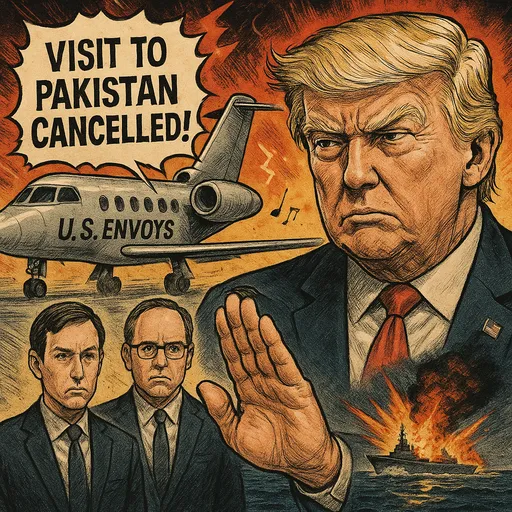
A flurry of reports describe President Trump’s decision to cancel or suspend a planned visit by U.S. envoys (including Jared Kushner and Michael Witkoff) to Pakistan, a move many sources portray as a setback for attempts to mediate tensions with Iran. U.S.-focused coverage emphasizes the administration’s rationale and Trump’s criticism of lengthy envoy travel, framing the decision as a pragmatic halt rather than an escalation. Regional and international outlets cast the cancellation as damaging to fragile peace efforts and warn it could complicate Pakistan’s role as an intermediary. A smaller set of reports note that emissaries had been dispatched or visits planned before the reversal, while an unrelated U.S. strike at sea appears in one report, underscoring concurrent U.S. security actions in the wider region.
These sources foreground the White House message that envoy travel was canceled because it was judged unproductive, relaying Trump’s remarks and the administration’s framing of the move as practical rather than escalatory. Coverage emphasizes presidential commentary and immediate U.S. decision-making, portraying the cancellation as an internal policy judgment about diplomatic costs and benefits.
These outlets emphasize the cancellation as a diplomatic setback that undermines hopes for breakthroughs in talks related to Iran, highlighting concern among analysts and regional actors. The reporting frames the decision as complicating mediation, reducing momentum for negotiated solutions, and increasing uncertainty about the prospects for de-escalation.
This group focuses on the earlier diplomatic outreach: reports that emissaries were sent or a presidential visit was being prepared, underlining that active U.S. engagement with Pakistan had been underway before the reversal. Coverage notes efforts to coordinate with Islamabad as part of broader attempts to influence Iran, and highlights mixed signals when planned contacts are then canceled or postponed.
Pakistan-focused pieces stress the immediate diplomatic impact on Islamabad, describing uncertainty for Pakistani officials and the city’s constrained diplomatic atmosphere as negotiations stall. These reports reflect local concern about lost opportunities for engagement on security, trade and counterterrorism cooperation tied to the U.S. outreach.
One report included in the set details an unrelated U.S. strike on a vessel suspected of drug trafficking, showing concurrent U.S. security activity even as diplomatic initiatives faltered. The piece is treated separately because it highlights military enforcement actions rather than the Pakistan-focused diplomacy central to the other stories.