
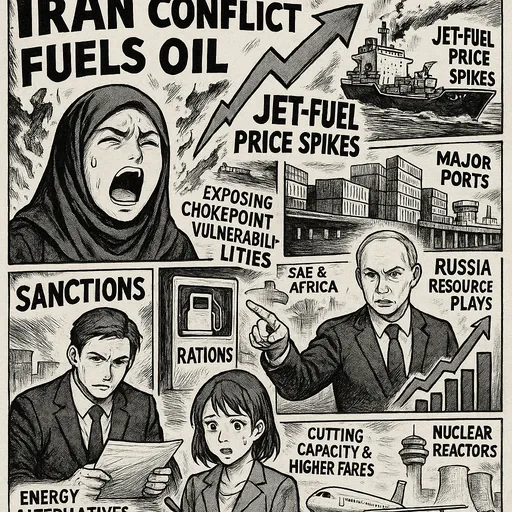
The Iran-related conflict is driving oil and jet-fuel price spikes and exposing chokepoint vulnerabilities from the Strait of Hormuz to major ports, prompting market volatility and policy responses. Western actors are tightening sanctions and exploring alternative energy corridors and infrastructure to reduce exposure, while some governments consider emergency measures such as fuel rationing. Airlines and travel markets are already cutting capacity and warning of higher fares as jet-fuel shortages spread, and regional actors from Southeast Asia to Africa are bolstering maritime security and stockpiles to protect supply chains. Concurrently, Russia is advancing resource plays and partnerships, nuclear safety debates and new reactor plans are resurfacing, and efforts to diversify critical-minerals supplies and regulate new extraction technologies are gaining momentum.
Western policymakers and market commentators frame the Iran war as a direct threat to global energy flows and prices, advocating sanctions enforcement and alternative routing to reduce dependence on vulnerable chokepoints. The perspective emphasizes coordinated economic and diplomatic measures to stabilize markets and shield European and global economies from supply shocks.
Airlines and industry executives highlight acute jet-fuel shortages and rising oil costs caused by Middle East tensions, pushing carriers to cut flights and warn of fare increases. Their view stresses immediate commercial impacts and the need for operational adjustments to manage fuel supply and cost risks.
Southeast Asian governments and regional leaders prioritize securing vital shipping lanes and building cooperative stockpiles and emergency plans to protect trade and energy flows. This perspective focuses on practical, regional measures—maritime patrols, contingency reserves and multilateral coordination—to reduce vulnerability to distant conflicts and piracy.
Russian actors are depicted as consolidating control over resources, informing partners about energy plans, and deepening bilateral cooperation—both in traditional hydrocarbons and renewable projects—while advancing domestic technological breakthroughs. Observers view these moves as Moscow leveraging energy assets for geopolitical influence and resilience amid Western pressure.
International institutions and national commentators stress that nuclear energy remains politically and technically contentious: calls for strict safeguards and lessons from Chernobyl sit alongside plans to build small modular reactors. The perspective balances enthusiasm for nuclear's role in energy security with warnings about transparency, safety and governance.
Western governments present a strategic agenda to reduce dependence on China for critical minerals through cooperation and investment, while civil society in the Pacific raises environmental and governance concerns about deep-sea mining deals. The dual view highlights both state-led supply-chain diversification and local demands for stronger safeguards.
National-level responses vary from external assistance to calls for internal conservation: donor states fund power projects to shore up supply, while governments under sanctions urge consumers to cut usage to cope with shortages. The perspective emphasizes practical, often short-term measures to maintain energy services and social stability.