
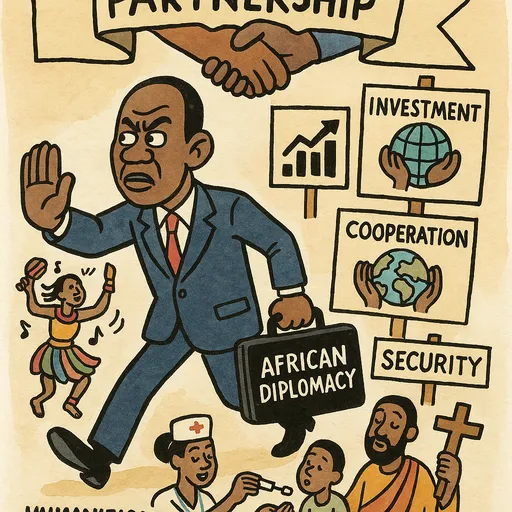
Recent reporting shows African public diplomacy focused on rebuilding partnerships, attracting investment and convening regional cooperation while managing reputational and security challenges. Several countries are using state visits, business forums and credentialing ceremonies to deepen ties with European, Asian and regional partners and to restart stalled infrastructure and institutional reforms. Soft-power initiatives — cultural celebrations, leadership awards, and participation in global forums — sit alongside warnings to diasporas and high-profile gaffes that risk diplomatic fallout. Health, refugee returns and faith-led public health campaigns illustrate continued humanitarian and development diplomacy across the continent.
Coverage highlights a diplomatic misstep by Kenya’s president as seen from a Beninese perspective, framing it as symptomatic of broader rivalries and stereotypes in Africa. The focus is on reputational consequences and inter-state perceptions sparked by the incident.
Guinea‑Bissau emphasizes institutional development and media capacity through ministerial exchanges in Lisbon to strengthen INACEP. The perspective stresses learning and technical cooperation without immediate binding agreements.
Libyan reporting centers on reviving international economic partnerships (Spanish forum, Korean housing talks) and bolstering governance via UN support for institutional independence. The strand highlights reconstruction, access to markets and legitimacy of public bodies.
The piece underscores France‑Africa cultural and diplomatic links through an award recognizing African women leaders. It frames the honor as a marker of Franco‑African engagement on gender and leadership issues.
Equatorial Guinea projects its linguistic and cultural ties by participating in Spanish Language Day events in Addis Ababa, using cultural diplomacy to reinforce its international profile. The account emphasizes symbolic outreach within multilateral cultural spaces.
The Liberian report functions as an obituary for a senior political figure who had been designated ambassador, noting the human and diplomatic consequences of his death en route abroad. The perspective reflects on personal contributions to public life and impending diplomatic gaps.
Coverage promotes regional collaboration on health at the World Health Summit meeting in Nairobi, stressing partnership-building among governments, NGOs and donors. The framing highlights Africa-led agenda setting for health policy and resource mobilization.
From a Portuguese angle, the story focuses on the killing of Madeira‑descended businesspeople in South Africa and the effects on the diaspora community. It underlines safety concerns for nationals abroad and bilateral human consequences.
The Maore Committee’s statements reflect Comorian concern over security and migration linked to Mayotte, calling for accountability and policy responses. The tone is advocative, seeking action from national and regional authorities.
Reporting from the Vatican spotlights the Church’s leading role in unexpected hepatitis successes in Burkina Faso, framing faith institutions as key public‑health partners. The narrative emphasizes community outreach and non‑state actor contributions to health diplomacy.
Namibian coverage analyzes political leadership crises and party dynamics in neighbouring countries (South Africa, Zambia), reflecting concern over governance, accountability and regional stability. The pieces take an analytical tone on implications for public trust and inter‑state relations.
Cape Verdean reporting criticizes external media for allegedly denigrating São Tomé’s image and highlights regional electoral violence (Tanzania) with attention to reputational and humanitarian costs. The perspective is protective of national image and attentive to regional security fallout.
Djiboutian reporting records congratulatory diplomacy following President Guelleh’s re‑election, emphasizing continuity in foreign ties and international affirmation. The perspective stresses ceremonial diplomacy and sustained bilateral goodwill.
Rwanda combines routine diplomatic acts (presentation of credentials) with regional integration ambitions (joint refinery) and presidential commentary on global affairs. The cluster presents Rwanda as simultaneously consolidating bilateral representation, pursuing regional economic projects, and engaging in strategic geopolitics.
Nigerian coverage warns citizens in South Africa about rising violence while also assessing a narrow diplomatic window for Niger‑Benin relations to be reset. The perspective mixes consular protection with commentary on urgent regional diplomatic maneuvers.
Burkinabè reporting records the official welcome of Mali’s prime minister at an event, focusing on ceremonial diplomacy and bilateral courtesy. The angle is formal and centered on protocol and regional engagement.
Botswana’s coverage frames Foot‑and‑Mouth Disease outbreaks as a trade and diplomatic challenge after the EU suspended beef imports, linking domestic disease control to international trade relations. The emphasis is on containment measures and maintaining export market confidence.
CAR’s president attending the World Government Summit signals engagement in global governance forums to attract partnerships and discuss development priorities. The piece frames participation as part of international outreach and strategic partnership building.
US‑sourced reporting highlights Morocco’s $700M skyscraper as a symbol of economic ambition and efforts to boost international attractiveness. The narrative treats infrastructure as a component of national branding and investment diplomacy.
Ethiopian diplomacy is shown as highly active: ministers and the prime minister are meeting European counterparts and neighbouring heads of state to boost trade, investment, climate action and regional cooperation. The texts present Ethiopia as a hub for bilateral and regional agenda‑setting, leveraging high‑level visits and forums.
Togo is portrayed as balancing relations with Russia while coordinating with France on peace efforts in the Great Lakes, reflecting a hedging strategy between East and West and a commitment to regional stability. The perspective emphasizes pragmatic diplomacy across security and development tracks.
Tanzanian coverage spotlights former and current leaders engaging in international leadership programs, gender‑equality diplomacy, and celebrations of East African innovation. The cluster stresses soft‑power through training, multilateral networks and high‑profile honours.
Sudanese reporting focuses on organized voluntary return flights from Uganda, framing repatriation as part of managed humanitarian and migration diplomacy. The perspective highlights coordination mechanisms and the ongoing nature of refugee returns.
Mauritanian coverage presents bilateral discussions with the UK aimed at strengthening cooperation on refugee support and border management. The angle underscores international partnerships in humanitarian and security policy areas.
Guinean reporting blends emotive domestic coverage of a notable death with announcements about an incoming visit from Guinea‑Bissau’s prime minister, combining remembrance with ongoing regional diplomacy. The perspective links internal social ties to broader cooperative engagements.