

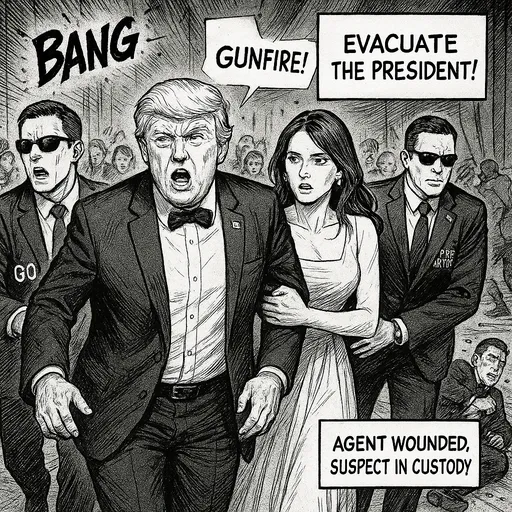
Gunfire at the White House Correspondents' Dinner prompted a rapid Secret Service evacuation of President Donald Trump, the First Lady and other attendees; officials across outlets report the president was unharmed and praised protective agents. Authorities detained a suspect at the scene and initial accounts say an agent was wounded but survived, while investigators — including the FBI in some reports — are reviewing footage, weapons and motives. International coverage split between immediate reassurances and intense visual documentation, with many outlets publishing videos and photos of the moments of chaos and evacuation. The incident also revived historical comparisons to the Washington Hilton shooting of 1981 and prompted renewed scrutiny of venue security and checkpoint procedures as officials promise fuller reviews and potential charges.
These sources emphasize the immediate protective response: the Secret Service evacuated President Trump and attendees, reported the president and other officials safe, and highlighted praise for agents. Coverage centers on rapid security actions, official statements and the absence (in many reports) of fatal injuries while investigators secure the scene.
 Trump evacuated from media dinner after gunshots; supporters say another assassination attempt
US Prez & First Lady safe after shooting at White House: Trump holds press conference
Trump evacuated from media dinner after gunshots; supporters say another assassination attempt
US Prez & First Lady safe after shooting at White House: Trump holds press conference
 Shooting at dinner attended by U.S. President Donald Trump and his cabinet.
 Secret Service evacuates Trump from the White House Correspondents' Dinner after gunfire
Trump removed from a dinner with reporters after gunshots were heard
Secret Service evacuates Trump from the White House Correspondents' Dinner after gunfire
Trump removed from a dinner with reporters after gunshots were heard
 Shots Reported: President Trump Safely Secured at a Press Dinner
 Donald Trump evacuated after shots fired during the correspondents' dinner
 Trump survives third assassination attempt in three years
Trump thanks Secret Service after assassination attempt
Trump evacuated from correspondent dinner in the USA after shooting
Trump survives third assassination attempt in three years
Trump thanks Secret Service after assassination attempt
Trump evacuated from correspondent dinner in the USA after shooting
 Shots heard at White House correspondents dinner; Trump safe after being evacuated
Trump said the incident was ‘probably a lone shooter’
Shots heard at White House correspondents dinner; Trump safe after being evacuated
Trump said the incident was ‘probably a lone shooter’
 Trump says shooter was 'far away' from him after the correspondents' dinner shooting
Trump says the shooter was 'intercepted' by the Secret Service after firing at an agent
Trump says, after evacuation from a dinner in Washington, that a shooter has been detained
Secret Service evacuates Trump from correspondents' dinner after apparent gunfire
Trump says shooter was 'far away' from him after the correspondents' dinner shooting
Trump says the shooter was 'intercepted' by the Secret Service after firing at an agent
Trump says, after evacuation from a dinner in Washington, that a shooter has been detained
Secret Service evacuates Trump from correspondents' dinner after apparent gunfire
 Incident in Washington: Trump evacuated to safety after shots outside the correspondents' dinner – suspect arrested
 Donald Trump evacuated from White House Correspondents' Dinner after shootings
 Trump evacuated from the White House Correspondents' Dinner after shooting
 Shots fired in hotel at the Correspondent's Dinner: Trump evacuated, no injuries
 Secret Service evacuated Donald Trump from gala after shooter opened fire at Hilton Hotel.
 Evacuation of President Donald Trump from an official ceremony after report of gunfire
 President Donald Trump speaks after being evacuated from the White House Correspondents' Dinner: 'The shooter has been detained'
 Trump evacuated from dinner after shooting
 US President Trump evacuated from White House Correspondents' Dinner
 Donald Trump says the attacker was far away during incident at the White House Correspondents' Dinner
Trump calls crazy the alleged shooter who burst into the hotel during the White House Correspondents' Dinner
Donald Trump says the attacker was far away during incident at the White House Correspondents' Dinner
Trump calls crazy the alleged shooter who burst into the hotel during the White House Correspondents' Dinner
 Live: Trump says the alleged shooter at the correspondents' dinner has been detained; preparing press conference, following minute by minute
 Trump unharmed and safe after shooting at the White House correspondents' dinner
Trump and the First Lady evacuated — shooter fired
Trump unharmed and safe after shooting at the White House correspondents' dinner
Trump and the First Lady evacuated — shooter fired
 Trump says shooter 'has been apprehended'
 Security incident at White House Correspondents' Dinner -- report
 Shots Fired, Trump Evacuated Unhurt From Press Dinner In Washington
 Donald Trump evacuated and unharmed after shots at the White House Correspondents' Dinner
 Shooting occurred at a reception with Trump in Washington; one detainee
Trump and the First Lady evacuated from a dinner in Washington
Shooting occurred at a reception with Trump in Washington; one detainee
Trump and the First Lady evacuated from a dinner in Washington
 ‘Quite an evening in DC’ — Trump praises Secret Service after correspondents’ dinner shooting scare
 Gunfire at journalist dinner; Trump evacuated safely
 Trump on shooting: ‘I heard a noise and thought it was a tray. But it was a gun’
Lone wolf: Trump speaks after shots fired at dinner event; suspect in custody
Trump safe after being rushed from White House correspondents dinner, shooter in custody
Trump on shooting: ‘I heard a noise and thought it was a tray. But it was a gun’
Lone wolf: Trump speaks after shots fired at dinner event; suspect in custody
Trump safe after being rushed from White House correspondents dinner, shooter in custody
 US Secret Service evacuates Donald Trump from White House Correspondents' Dinner after apparent gunfire
 Washington: Alarm at the White House Correspondents' Dinner, Trump escorted out
LIVE - Trump evacuated from the White House Correspondents' Dinner after gunfire
Washington: Alarm at the White House Correspondents' Dinner, Trump escorted out
LIVE - Trump evacuated from the White House Correspondents' Dinner after gunfire
 No US administration officials injured in shooting - Trump
 Traditional White House Correspondents' Dinner: Shooting at a prestigious event attended by Trump
 Trump safe after security incident at White House correspondents dinner
 The President of the United States, Donald Trump, was escorted from the White House Correspondents' Dinner after an incident on Saturday night.
Trump evacuated after shots fired, a suspect arrested
The President of the United States, Donald Trump, was escorted from the White House Correspondents' Dinner after an incident on Saturday night.
Trump evacuated after shots fired, a suspect arrested
 Night of Chaos
DURING THE EVENING: Drama in Washington: Trump and Melania evacuated, Secret Service shouted 'gunfire', guests fled
Night of Chaos
DURING THE EVENING: Drama in Washington: Trump and Melania evacuated, Secret Service shouted 'gunfire', guests fled
 Donald Trump evacuated after shooting on the outskirts of the White House Correspondents' Dinner
Trump evacuated from a dinner with journalists due to gunfire
Donald Trump evacuated after shooting on the outskirts of the White House Correspondents' Dinner
Trump evacuated from a dinner with journalists due to gunfire
 Trump evacuates from Washington hotel after gunfire; says he, his wife and the vice president are safe, praising the Secret Service
 Trump says the shooter was intercepted by the Secret Service after firing at an agent
Secret Service evacuates Trump from the Correspondents' Dinner after apparent gunfire
Trump says the shooter was 'far away' from him after the shooting at the correspondents' dinner
Alert: Secret Service evacuates Trump from the correspondents' dinner after apparent gunfire
Trump says the shooter was intercepted by the Secret Service after firing at an agent
Secret Service evacuates Trump from the Correspondents' Dinner after apparent gunfire
Trump says the shooter was 'far away' from him after the shooting at the correspondents' dinner
Alert: Secret Service evacuates Trump from the correspondents' dinner after apparent gunfire
 Trump evacuated after shots at the White House Correspondents' Dinner
These reports focus on the assailant: identification, arrest, the types of weapons carried and official characterizations of the attacker (e.g., 'lone wolf'). Many outlets published details and photos of the suspect, noted injuries to an agent, and underscored charges or investigations that may follow.
Photos and video of the shooting suspect at the dinner where President Trump was present
Trump calls the attacker at the White House Correspondents' Dinner a 'lone wolf'
Trump evacuated from dinner after shooting
Trump: Suspect stormed security checkpoint with multiple weapons
Trump says alleged shooter at dinner event in custody, officer shot but doing well
 Shots fired at the hotel where Trump met journalists; attacker detained.
 Gunman held, Trump uninjured after shots fired at White House correspondents' dinner
 Trump says shooting suspect was armed with multiple weapons before being stopped by Secret Service
Get down': Suspected shooter in custody after Trump rushed from Washington event
Trump says shooting suspect was armed with multiple weapons before being stopped by Secret Service
Get down': Suspected shooter in custody after Trump rushed from Washington event
 Threat in the United States. Trump confirmed that the shooter was detained: 'A lone wolf'
Minute-by-minute account of the White House attack: Trump says the attacker had a long gun and wounded an agent
Trump releases security breach footage, shooter's photos after WH Correspondents' Dinner chaos
Trump: alleged attacker detained after shots during the Correspondents' Dinner
Threat in the United States. Trump confirmed that the shooter was detained: 'A lone wolf'
Minute-by-minute account of the White House attack: Trump says the attacker had a long gun and wounded an agent
Trump releases security breach footage, shooter's photos after WH Correspondents' Dinner chaos
Trump: alleged attacker detained after shots during the Correspondents' Dinner
 Gunfire incident at a White House dinner – Trump evacuated, suspect identified
Trump posted a video of the suspect after the Washington shooting
Trump describes gunman charging security checkpoint and firing
Who is Cole Tomas Allen, 31, the suspected attacker, Californian engineer: what we know. Trump posts his photo on Truth
Gunfire incident at a White House dinner – Trump evacuated, suspect identified
Trump posted a video of the suspect after the Washington shooting
Trump describes gunman charging security checkpoint and firing
Who is Cole Tomas Allen, 31, the suspected attacker, Californian engineer: what we know. Trump posts his photo on Truth
 Shots fired, Trump evacuated from press dinner in Washington
Shooter at Washington reception had several types of weapons - Trump
One person arrested after shooting at Trump reception
Trump safe after shots fired at White House correspondents’ dinner, suspected gunman detained
A suspect was quickly apprehended; gunfire at the White House Correspondents' Dinner; Trump shares photos of the arrested suspect
Shots fired, Trump evacuated from press dinner in Washington
Shooter at Washington reception had several types of weapons - Trump
One person arrested after shooting at Trump reception
Trump safe after shots fired at White House correspondents’ dinner, suspected gunman detained
A suspect was quickly apprehended; gunfire at the White House Correspondents' Dinner; Trump shares photos of the arrested suspect
 Gunman detained after hotel shooting near the US president
ARRESTED: Attacker identified at the White House; it's a teacher from California?
MAN BREACHED SECURITY: Trump says 'Melania and I are in perfect shape!' Shooter captured
Donald Trump confirmed the arrest of Cole Tomas Allen after the shooting at the White House Correspondents' Dinner
Exclusive photos: Trump shows the suspect after attack at a dinner
Trump says a shooter has been detained after being evacuated in Washington
A shooter is arrested after firing at the Washington correspondents' dinner
Gunman detained after hotel shooting near the US president
ARRESTED: Attacker identified at the White House; it's a teacher from California?
MAN BREACHED SECURITY: Trump says 'Melania and I are in perfect shape!' Shooter captured
Donald Trump confirmed the arrest of Cole Tomas Allen after the shooting at the White House Correspondents' Dinner
Exclusive photos: Trump shows the suspect after attack at a dinner
Trump says a shooter has been detained after being evacuated in Washington
A shooter is arrested after firing at the Washington correspondents' dinner
 Cole Allen: A 31-year-old teacher was the perpetrator behind the White House Correspondents' Dinner attack – He was armed with a rifle, a pistol and multiple knives.
These outlets foreground visual evidence and firsthand testimony, sharing video clips, photo galleries and minute-by-minute or eyewitness descriptions of the moment shots were heard and security moved in. The coverage highlights chaotic scenes, attendees diving for cover, and the visible actions of agents during the evacuation.
Watch: Donald Trump ducks for cover as security rushes to evacuate him after shots heard at White House press dinner
Tension in the United States. The videos of the moment when the Secret Service evacuated Donald Trump
Video of the exact moment when Donald Trump is evacuated during the White House Correspondents' Dinner: shots heard
Videos show Secret Service evacuating Trump after apparent gunshots
Video: How Trump and the First Lady were evacuated from the Correspondents' Dinner in Washington
Videos: How the Secret Service protected Trump from gunfire at the correspondents' dinner; Secret Service detains attacker
First you hear the shots, then Trump is evacuated
Video: Trump rushed off stage after shots fired
Stefan tells IS about the chaos at the shooting site
In Photos: Security incident at White House correspondents dinner
'A BLAST WAS HEARD': First photos of panic at a Trump gala: 'People jumped under tables'
In 10 photos: Gun attack strikes at Trump dinner with journalists
Moments of terror: How the gun attack at the Trump journalists' dinner unfolded
Trump evacuated from dinner after gunfire; attendees hid under tables as shots rang out; hotel official says a suspect was down
In photos: how Donald Trump was evacuated after shots at the Washington correspondents' dinner
These pieces stress post-incident probes and questions about protective measures, noting FBI involvement, security reviews and expert critiques of checkpoint vulnerabilities. Coverage argues the episode will prompt formal inquiries and possible revisions to security protocols at high-profile events.
 FBI Steps In to Investigate Shooting at White House Dinner
Gunfire Erupts at White House Dinner, Security Questioned
Trump's message after the attack on the White House
Shots interrupted White House dinners in Washington
U.S. Secret Service investigates shooting at event attended by Trump
FBI Steps In to Investigate Shooting at White House Dinner
Gunfire Erupts at White House Dinner, Security Questioned
Trump's message after the attack on the White House
Shots interrupted White House dinners in Washington
U.S. Secret Service investigates shooting at event attended by Trump
 Drama and panic at a gala as Trump is evacuated by Secret Service; gunfire heard as an armed man stormed the hotel
A set of reports place the incident in historical perspective, recalling the 1981 assassination attempt on President Reagan and the Washington Hilton's past role in presidential security scares. They draw parallels to earlier crises to underline the symbolic weight and legacy of attacks near presidential events.
From Ronald Reagan to Donald Trump: How Washington Hilton hotel became scene of panic once again
 Hotel from which Trump was evacuated after shootings this Saturday is the same one where Reagan was shot in 1981
John Hinckley Jr. shooter who attempted to assassinate President Reagan in 1981, reportedly to impress Jodie Foster
Hotel from which Trump was evacuated after shootings this Saturday is the same one where Reagan was shot in 1981
John Hinckley Jr. shooter who attempted to assassinate President Reagan in 1981, reportedly to impress Jodie Foster
 45 Years After Reagan's Assassination Attempt, the Washington Hilton Nightmare Returns
Shots at the same hotel: Trump evacuated and recalls Reagan’s 1981 attack
45 Years After Reagan's Assassination Attempt, the Washington Hilton Nightmare Returns
Shots at the same hotel: Trump evacuated and recalls Reagan’s 1981 attack