
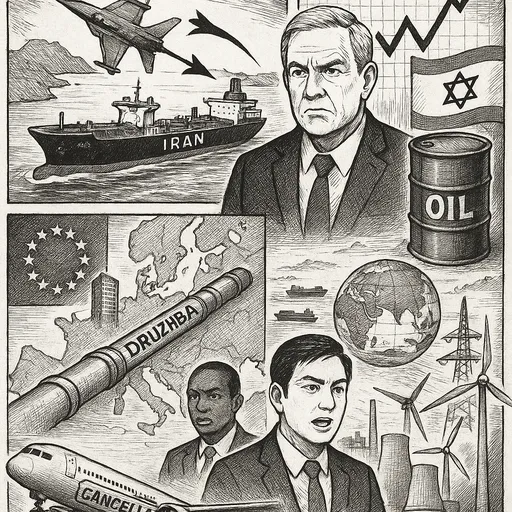
Recent reporting shows the Iran–US/Israel confrontation — and Tehran’s moves in the Strait of Hormuz — are the main near-term drivers of oil and fuel-market volatility, pushing prices higher and forcing operational responses such as airline flight cuts. European coverage highlights the renewed salience of pipelines (Druzhba) and the political trade-offs Brussels faces as it balances energy security, sanctions and diversification efforts. At the same time, an array of South–South deals and producer outreach (from Russia, Azerbaijan, Algeria, Libya and others) are reshaping supply routes and investment patterns, while regional actors from ASEAN to East Africa step up cooperation on stockpiles, shipping security and shared infrastructure. Amid rising short‑term disruption, several pieces also stress longer‑term strategic responses: national stockpiles, renewable and nuclear partnerships, and industrial policies designed to blunt future oil shocks.
Sources tracking Gulf developments frame Iran’s use of the Strait of Hormuz — seizures, tolls and threats to close the waterway — as a coercive lever that directly disrupts shipping and energy markets. Reporting emphasizes immediate consequences: spikes in oil prices, threats to LNG and aviation fuel supply, scams and security risks that force firms and states to adapt rapidly.
European reporting centers on the tussle between immediate supply needs and political objectives: restarting Druzhba flows, managing relations with Russia, and pushing diversification while policing third‑party pipeline projects. Brussels and national capitals are portrayed as juggling regulatory, geopolitical and commercial pressures as they try to keep supplies flowing without ceding strategic leverage.
Several outlets emphasize the real‑world economic fallout: rising input costs, corporate profit warnings and sharp price increases for goods that ripple down to consumers in many countries. Coverage highlights stress on aviation, manufacturing and households and frames these as early signs of broader macroeconomic strain from the energy shock.
Reports from a range of producer and developing‑country sources depict active diplomatic and commercial energy outreach — discounted Russian barrels, large supply agreements, Azerbaijani gas talks and new exploration partnerships — reflecting how suppliers are finding alternative markets and partners. This perspective underscores a reconfiguration of trade links and investment flows that can blunt Western leverage and deepen bilateral ties between producers and buyers.
Regional actors stress collective measures — from ASEAN oil stockpiling and Malacca‑lane security to joint refineries and cross‑border power links — as pragmatic responses to supply shocks and chokepoint risks. The reporting frames these moves as practical resilience-building that reduces dependency on single routes or suppliers.
Several pieces highlight long‑term strategic shifts: national decarbonization roadmaps, promotion of renewables, Chinese and Azerbaijani investments in green power, and nuclear engagement with developing countries. This viewpoint treats the current crisis as accelerating policy and investment choices aimed at reducing exposure to oil shocks over time.
Reporting on strikes and industrial incidents underscores the vulnerability of energy infrastructure to kinetic attacks and the cascading environmental and health consequences. These accounts link security threats directly to operational disruption, pollution and local humanitarian concerns.
Analytical pieces stress how the energy crisis and regional conflicts are shaping global influence, with commentators arguing that disruption to oil trade weakens some Western levers while offering strategic openings for rivals. The perspective connects energy market shifts to broader contests over credibility and geopolitical positioning.